

From imagined hạnh phúc to conditional incorporation
Vietnamese female marriage migrants and their multi-ethnic children across Korea and Vietnam
* Southern Institute of Social Sciences, Vietnam Academy of Social Sciences, Vietnam, tybao510@yahoo.com
DOI: https://doi.org/10.33334/sieas.2026.45.2.101
Abstract
This article examines how the meaning of hạnh phúc (happiness) changes across the stages of marriage formation, settlement in Korea, and return to Vietnam among Vietnamese female marriage migrants and their multi-ethnic children. Rather than treating hạnh phúc simply as an individual sense of happiness, the article understands it as a socially and culturally embedded aspiration shaped by family obligations, mobility projects, and institutional conditions. Drawing on secondary demographic statistics and policy documents from Korean and Vietnamese sources (2000–2025), the study develops a transnational analytical framework of hạnh phúc to trace how gendered migration regimes shape migrants’ experiences across the Korea–Vietnam migration corridor. Marriage migration was initially imagined as a pathway to collective family hạnh phúc through economic and social exchange. During settlement, however, hạnh phúc became tied to a regime of conditional incorporation structured around caregiving responsibilities and legal status within Korea’s migration system. Upon return, hạnh phúc is renegotiated through extended family networks and transnational belonging, while remaining constrained by institutional gaps in civil registration, education, and welfare support in Vietnam. The analysis suggests that migration regimes reshape migrants’ understandings of hạnh phúc across different stages of migration while generating new forms of institutional vulnerability that extend beyond national borders.
I. Introduction
Studies of Vietnamese–Korean marriage migration have primarily focused on marriage brokerage, migrant adaptation, multicultural family policies, citizenship, and the incorporation of marriage migrants into Korean society. Other studies have examined return migration and the challenges faced by female returnees and their multi-ethnic children in Vietnam. While these studies have generated important insights, they tend to examine marriage formation, settlement, and return as separate processes. Less attention has been paid to how migrants’ understandings of hạnh phúc change across these interconnected stages and how migration regimes in both Korea and Vietnam shape these transformations over time.
This article develops a transnational analytical framework of hạnh phúc to examine how migration regimes shape the life-course experiences of Vietnamese female marriage migrants and their multi-ethnic children across Korea and Vietnam. The framework highlights how the meaning of hạnh phúc evolves across the stages of marriage formation, settlement in Korea, and return to Vietnam.
The transnational analytical framework of hạnh phúc conceptualises hạnh phúc as a socially embedded and relational process rather than a fixed outcome or individual emotional state. It examines how understandings of hạnh phúc are shaped, transformed, and renegotiated across three interconnected stages of migration: marriage formation, settlement in Korea, and return to Vietnam. By linking these stages within a single analytical perspective, the framework highlights how demographic conditions, migration governance, and family relationships jointly influence migrants’ pursuit of hạnh phúc across national borders.
Since the late 1990s, marriage migration between Vietnam and Korea has been widely discussed in terms of demographic change, rural bachelorhood, and migration policy (Bélanger et al. 2010; Lee 2015). Yet at the centre of these movements lies a concept repeatedly invoked by Vietnamese female marriage migrants themselves: hạnh phúc. Although often translated as “happiness”, hạnh phúc carries moral, relational, and socio-economic meanings that extend beyond an individual emotional state. It refers not only to personal well-being but also to family fulfilment, responsibility, dignity, aspirations for intergenerational mobility, and the well-being of significant others. For many women, hạnh phúc is inseparable from obligations to parents, children, and extended family members. The article therefore retains the Vietnamese term hạnh phúc rather than replacing it entirely with the English term happiness. While happiness is often used to describe an individual emotional condition, hạnh phúc encompasses broader family-centred and socially embedded meanings that are central to how participants understand migration, marriage, and family life. Retaining the Vietnamese term allows the analysis to remain closer to participants’ own understandings and avoids reducing a culturally grounded concept to a narrower English equivalent.
For many women, marriage migration was imagined as a pathway toward hạnh phúc—a better life for themselves and their families. However, as these women settled in Korea, their aspirations increasingly became shaped by institutional arrangements that link legal security to caregiving roles and marital continuity. In this sense, the pursuit of hạnh phúc became embedded within a regime of conditional incorporation, in which belonging and stability are granted through gendered expectations of care. Tracing this shift from imagined hạnh phúc to institutionalised conditional incorporation provides a lens for understanding how migration regimes produce long-term vulnerabilities across both Korea and Vietnam.
Building on this perspective, this article examines Vietnamese–Korean marriage migration through a transnational analytical framework of hạnh phúc, tracing how the meaning of hạnh phúc evolves across the stages of marriage formation, settlement in Korea, and return to Vietnam under changing demographic and institutional conditions. Rather than treating demographic growth as background context, the analysis demonstrates how the scale of migration itself contributed to the development of Korea’s care-based visa regime while simultaneously generating institutional vulnerabilities for returnee families in Vietnam.
To clarify the analytical logic of this study, the framework links three stages of migration: formation, settlement, and return. In the formation stage, marriage migration can be understood through social exchange and subjective well-being perspectives, in which transnational marriage is imagined as a pathway toward collective family hạnh phúc under conditions of demographic and economic inequality. During settlement in Korea, the pursuit of hạnh phúc becomes increasingly structured by immigration governance, particularly visa regimes that connect legal stability to caregiving responsibilities, producing what can be described as conditional incorporation. In the return stage, hạnh phúc is renegotiated through transnational family networks as female returnees and their multi-ethnic children navigate institutional gaps in civil registration, education, and welfare in Vietnam.
These theoretical perspectives are not treated as competing explanations. Rather, they are used to illuminate different stages of the migration process. Together, they provide an integrated framework for analysing how hạnh phúc is imagined, institutionalised, and renegotiated across the migration life course. Taken together, the three stages show that the meaning of hạnh phúc changes across the migration process and is shaped by demographic conditions, migration policies, and cross-border institutional arrangements. The analytical framework is illustrated in Figure 1.
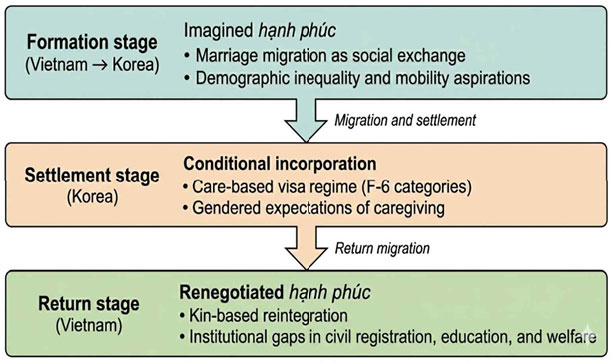
Stages of migration linking marriage formation, settlement in Korea, and return to Vietnam.
This article makes two contributions to the study of marriage migration and migration governance in East Asia. First, it develops a transnational analytical framework that connects marriage formation, settlement, and return within a single analytical perspective, showing how the meaning of hạnh phúc evolves across these stages. By linking these processes, the study highlights how migration regimes reshape migrants’ aspirations, family strategies, and understandings of well-being over time. Second, by linking demographic statistics and policy analysis from Korea and Vietnam, the study demonstrates how vulnerabilities produced within Korea’s care-based migration regime extend beyond settlement and continue to shape reintegration outcomes after return.
The article proceeds as follows. The first section traces the historical and demographic conditions that shaped marriage formation between Vietnam and Korea. The second examines settlement processes and the emergence of conditional incorporation within Korea’s migration regime. The third analyses the return and reintegration of Vietnamese female returnees and their multi-ethnic children in Vietnam. The final section discusses the findings through the framework of hạnh phúc and considers their implications for migration governance across both countries.
While previous studies have examined marriage brokerage (Bélanger & Wang 2012), settlement and multicultural policies in Korea (Lee 2015; Jang 2022), or transnational family relations and return migration (Yeoh et al. 2013; Yeoh et al. 2021), few studies have connected marriage formation, settlement, and return within a single analytical framework. By focusing on hạnh phúc as an evolving and socially negotiated process, this study links these stages and examines how migration regimes shape migrants’ aspirations and vulnerabilities across the entire migration trajectory.
II. Data sources and methods
This study employs a secondary empirical analysis of demographic statistics and policy documents from Korea and Vietnam to examine Vietnamese–Korean marriage migration through a transnational analytical framework of hạnh phúc. Demographic and administrative statistics were drawn from official Korean sources, including the Ministry of Justice (Korea) and Statistics Korea (2000–2024), as well as international organisations such as the International Organization for Migration (IOM 2023). These data document marriage flows, visa distributions (especially F-6-1, F-6-2, and F-6-3), divorce trends, births in multi-ethnic families, and return indicators. Because Vietnam lacks national statistics on returnees, Korean administrative data, including divorce statistics reaching 1,215 cases in 2024, are used as proxy indicators to estimate return trends.
Demographic statistics and policy documents were analysed to identify institutional patterns across the stages of marriage formation, settlement in Korea, and return to Vietnam, rather than to generate new primary empirical findings. Policy documents and legal frameworks from both countries were examined to reveal underlying assumptions about citizenship, residency, family responsibilities, and social incorporation. By bringing these sources together, the study examines how migration governance shapes opportunities, constraints, and understandings of hạnh phúc across different stages of migration.
The analysis is guided by an integrated analytical approach drawing on five complementary perspectives: perspectives on subjective well-being (Diener 1984), social exchange theory (Blau 1964; Homans 1958), double burden theory (Hochschild and Machung 1989), the migration lifecycle perspective (Gmelch 1980), and transnationalism (Levitt and Schiller 2004). These perspectives are not treated as competing explanations. Instead, the migration lifecycle perspective provides the overarching structure linking the stages of marriage formation, settlement, and return. Within this structure, social exchange theory and perspectives on subjective well-being help explain how marriage migration is initially imagined as a pathway toward family hạnh phúc under conditions of demographic and economic inequality. Double burden theory is used to analyse how migrant women negotiate caregiving responsibilities, family expectations, and legal incorporation during settlement in Korea. Transnationalism helps explain how family relationships, support networks, and senses of belonging continue to operate across national borders after return. Together, these perspectives form a sequential analytical framework that traces how hạnh phúc is imagined, institutionalised, and renegotiated across different stages of the migration process.
No single theoretical perspective can adequately explain the changing meanings of hạnh phúc across all stages of migration. The five perspectives are therefore used in a complementary manner to illuminate different dimensions of the migration process.
This approach has several limitations. First, Vietnam lacks comprehensive national statistics on female returnees and their multi-ethnic children, making it necessary to rely on proxy indicators derived from Korean administrative data. Second, because the study is based primarily on demographic statistics and policy documents, it does not seek to produce new primary empirical findings about individual experiences. Rather, it aims to identify broader demographic and institutional patterns that shape migration trajectories across the Korea–Vietnam migration corridor. Nevertheless, the triangulation of demographic trends, policy analysis, and theoretical interpretation provides a basis for analysing hạnh phúc as a transnational process shaped by gendered institutional arrangements.
III. Historical and demographic shifts in Vietnamese–Korean marriages
1. Vietnam’s Đổi Mới reforms and the rural–urban divide
The Đổi Mới reforms, launched in 1986, shifted Vietnam from a centrally planned to a market-oriented economy. These reforms improved national economic performance, expanded private enterprise, and reduced poverty (Tran & Heo 2008; Barai 2009; Ngoc et al. 2021). However, they also intensified spatial and social inequalities. Urban areas benefited disproportionately from improved infrastructure, public services, and formal-sector employment opportunities, while many rural regions continued to rely on low-income agricultural production and informal labour arrangements (Tran & Heo 2008; World Bank 2012). For young rural women, especially in the Southeast and the Mekong Delta, limited educational opportunities and unstable local livelihoods constrained upward mobility.
In this context, marriage migration emerged as a strategic pathway for improving life chances. Korean partners were increasingly viewed as offering more stable economic prospects compared to opportunities available in local communities. From the late 1990s onward, this perception contributed to a growing number of women entering transnational marriages in the hope of achieving greater financial security and social mobility for themselves and their families (Yeoh et al. 2013).
Interview accounts from female returnees further illustrate how economic insecurity and family responsibilities shaped these decisions. A local Women's Union officer who had worked extensively with female returnees explained that economic hardship was a primary factor motivating many women to pursue marriage migration. According to her, marriage to a foreign partner was often viewed as an opportunity to improve family living conditions, support parents through remittances, and create better futures for younger siblings and children. She noted that marriage migration was widely associated with the hope of “changing one’s life” and achieving a more secure future for the family.
These dynamics demonstrate how structural conditions created by Đổi Mới shaped not only labour migration but also marriage migration. The rural–urban divide made marriage abroad not simply a personal choice but a response to unequal development outcomes.
Viewed through social exchange theory, these marriages can be understood as strategic exchanges in which women sought economic security, social mobility, and opportunities to support their families, while Korean partners and their families sought marriage, caregiving, and family continuity. Within this context, hạnh phúc was often imagined not as individual fulfilment alone but as collective family advancement achieved through migration. The pursuit of hạnh phúc was therefore closely linked to aspirations for economic improvement, filial responsibility, and intergenerational mobility, illustrating how migration decisions were embedded within broader family strategies rather than individual preferences alone.
2. Taiwan’s tightening of immigration and matchmaking regulations
In the late 1990s and early 2000s, Taiwan was a major destination for Vietnamese marriage migrants, largely through commercial matchmaking agencies linking rural Vietnamese women with Taiwanese men, many of whom were farmers or lower-middle-class workers (Bélanger & Wang 2012). Early policy narratives in both countries framed these marriages positively. Taiwan viewed them as a potential solution to rural bachelorhood, while many Vietnamese families regarded them as a pathway to economic advancement and social mobility.
By the early 2000s, however, the rapid growth of cross-border marriages in Taiwan generated increasing concern regarding commercial matchmaking practices and the potential exploitation of migrant women. Public debates and policy discussions increasingly called for stronger state oversight of transnational marriage brokerage.
In response, Taiwan introduced a series of regulatory reforms, including mandatory in-person interviews and stricter background checks for foreign spouses as part of marriage visa procedures (BOCA 20171)). In 2008, the government formally prohibited for-profit transnational marriage brokerage agencies and restricted operations to non-profit organisations (Tseng 2015). These measures significantly reduced the number of new marriage migrants entering Taiwan through commercial intermediaries.
As Taiwan’s policies became more restrictive, Korea emerged as a comparatively more accessible destination for Vietnamese women. Unlike Taiwan, Korea continued to support marriage migration through local government initiatives and matchmaking programmes aimed at addressing rural bachelorhood and demographic decline. Taiwan’s regulatory tightening therefore indirectly redirected marriage migration flows toward Korea, contributing to the rapid increase in Vietnamese–Korean marriages throughout the 2000s.
This shift reinforced the perception of marriage migration as a viable pathway to imagined hạnh phúc. For many Vietnamese women and their families, Korea increasingly appeared to offer opportunities for economic security, family advancement, and social mobility at a time when alternative migration pathways were becoming more restricted.
3. Korea’s government-supported marriage migration program targeting rural bachelors
In the 1990s and early 2000s, rural Korea experienced two concurrent demographic changes: population aging and a growing concentration of unmarried men. The out-migration of young women to urban areas for education and employment contributed to persistent gender imbalances in rural regions, particularly in farming provinces such as Chungcheong, Jeolla, and Gyeongsang (Moon 2005). These trends heightened concerns about the long-term viability of rural households and agricultural communities.
By the mid-1990s, policymakers and the media increasingly framed rural bachelorhood not only as an individual issue but as a broader challenge to rural sustainability. This framing generated political momentum for state intervention. National and local governments began promoting transnational marriages as part of rural development strategies, positioning marriage migration as a response to demographic decline and labour shortages.
Within this policy environment, several local governments launched the Nongchon Chonggak Jangga Bonaegi Saeop (Rural Bachelor Marriage Support Project), which provided financial support for men to participate in matchmaking tours to Vietnam, the Philippines, Cambodia, and other countries. These programs often operated in collaboration with private matchmaking agencies, combining public funding with commercial brokerage practices (Bélanger et al. 2010; Freeman 2005). Through these initiatives, marriage migration became institutionalised via local government involvement, logistical coordination, and subsidised costs for Korean men.
Although initially promoted as mutually beneficial, these programs also attracted growing criticism. Scholars and women’s rights organisations questioned their reliance on brokered arrangements and the limited safeguards in place for foreign women, raising concerns about unequal power relations and regulatory oversight (National Human Rights Commission of Korea 2025).
In recent years, such critiques have contributed to policy adjustments. As of April 2025, 25 local governments in Korea had discontinued or revised support-oriented ordinances and programmes for brokered international marriages, signalling a gradual shift away from demographic-driven recruitment and toward a more regulated, rights-conscious approach to transnational marriage governance (National Human Rights Commission of Korea 2025). From a subjective well-being perspective, these programs framed transnational marriage as a solution to demographic decline, aligning personal aspirations with national rural sustainability goals.
4. Demographic indicators of the migration surge
In Korea, government data show a rapid increase in the number of Vietnamese female marriage migrants from the early 2000s onward, with arrivals on spousal visas rising from fewer than 100 cases in 2000 to several thousand by the mid-2000s (Bui 2022). By the late 2000s, Vietnamese women had become one of the largest groups of marriage migrants in Korea, particularly in rural areas, where their numbers in some localities surpassed those of other nationalities (IOM 2023).
At the national level, international marriages in Korea expanded substantially between 2000 and 2020. The share of international marriages among all marriages rose from approximately 2.5% in 2000 to over 13% by 2020 (Statistics Korea 2020). Within this broader growth, marriages between Korean men and migrant women predominated, with Vietnamese women forming the largest group. As of September 2021, the Ministry of Justice reported that 168,638 foreign nationals were residing in Korea through marriage migration, of whom 25.1% were Vietnamese, the highest proportion among all nationalities (cited in Kwak et al. 2021). Vietnamese women also accounted for the vast majority of Vetnamese marriage migrants, indicating a strongly gendered migration flow.
As shown in Figure 2, Vietnamese women consistently emerged as the largest and fastest- growing group of marriage migrants in Korea from the mid-2000s onward, even as the overall volume of marriage migration fluctuated over time.
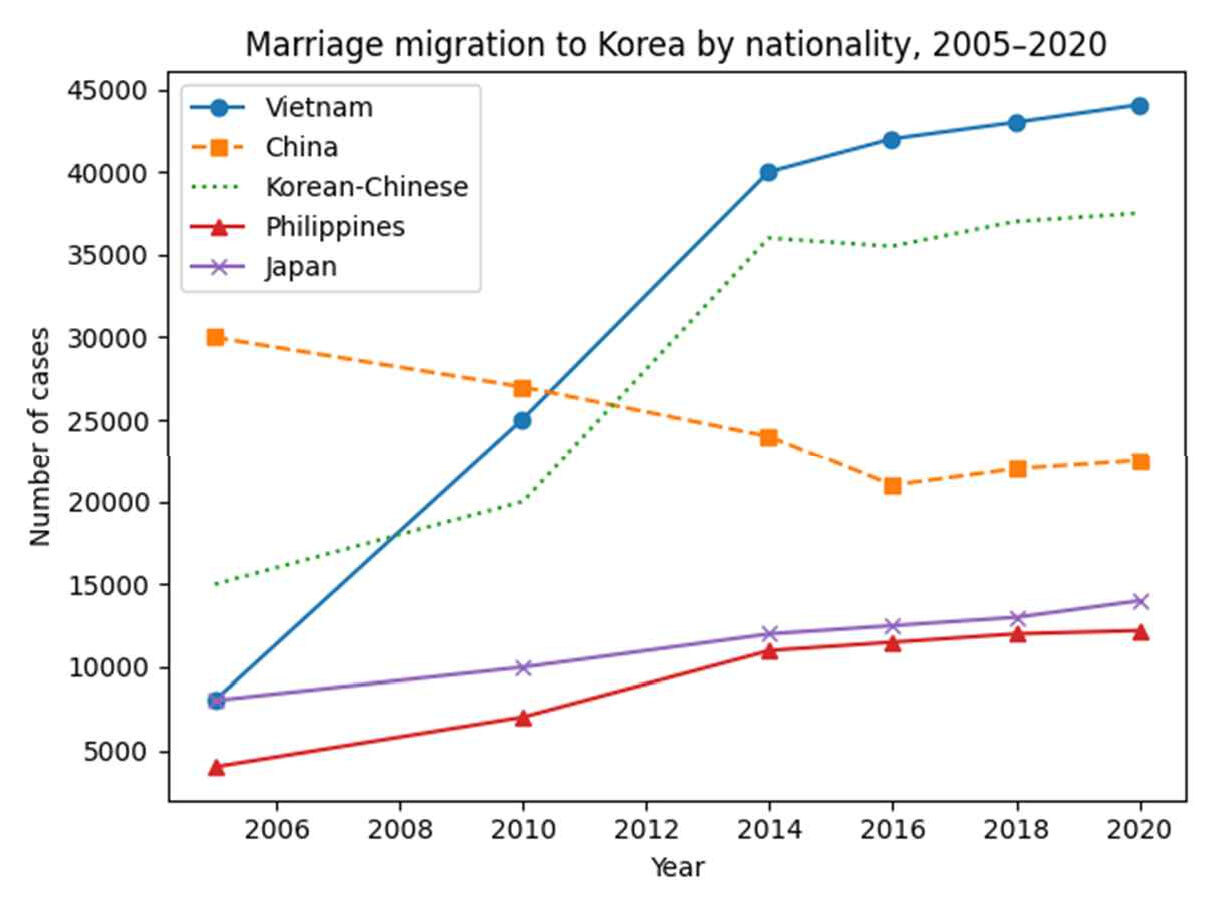
The figure shows a rapid increase in Vietnamese marriage migrants from the mid-2000s onward, contrasted with declining or slower growth among other groups. “Korean-Chinese” refers to ethnic Koreans holding a foreign nationality.
Source: Ministry of Justice, Korea (2021), cited in Kwak et al. (2021).
Between 2005 and 2020, the number of Vietnamese women migrating for marriage increased nearly sixfold, while growth among other nationalities remained considerably more modest. As a result, the share of Vietnamese migrants among all marriage migrants rose sharply, reaching more than one quarter by the late 2010s. Although overall marriage migration declined slightly in 2020 due to COVID-19 restrictions, the number of Vietnamese marriage migrants remained relatively stable.
Figure 3 further illustrates the consolidation of Vietnamese migrants as the dominant group within Korea’s marriage migration system by 2020, highlighting their relative resilience compared with other nationalities during the pandemic period.
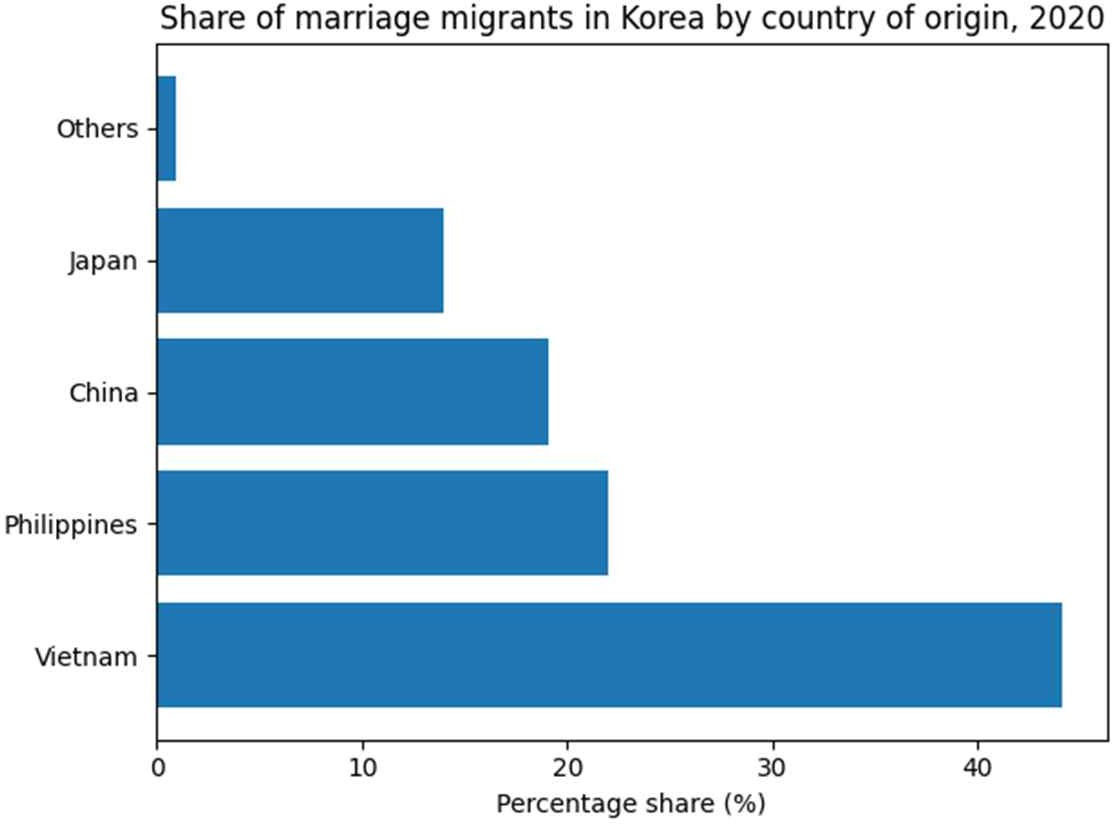
Vietnamese migrants constituted the largest group, accounting for over two-fifths of all marriage migrants, followed by migrants from the Philippines, China, and Japan.
Source: Ministry of Justice, Korea (2021), cited in Kwak et al. (2021).
Alongside marriage migration, the number of children born into multi-ethnic families also increased markedly. According to Statistics Korea, 16,421 children were born into multi-ethnic families in 2020, accounting for approximately 5.9% of all newborns nationwide. Among these, nearly 40% had Vietnamese mothers, making Vietnamese women the largest group of foreign- born mothers in Korea that year. Although the total number of births to immigrant or naturalised mothers declined in 2021 amid the pandemic, Vietnamese mothers continued to represent the largest share (Statistics Korea 2022).
Together, these demographic patterns indicate not only the expansion of marriage migration but also the demographic consolidation of Vietnamese–Korean multi-ethnic families. The rapid growth of these marriages reflected the widespread perception that transnational marriage could provide a pathway toward hạnh phúc through economic mobility, family advancement, and social security. The scale and durability of Vietnamese–Korean marriage migration also help explain why questions of settlement, legal incorporation, and eventual return became increasingly significant for both migrants and policy makers.
IV. Legal frameworks, settlement pathways, and family change
1. Visa categories, residency, and women’s caregiving responsibilities
As Vietnamese–Korean multi-ethnic families became more established, legal stability emerged as a central concern for marriage migrants seeking long-term settlement in Korea. Secure residency determines not only access to public services but also women’s capacity to plan for their children’s education, financial security, and future mobility. Changes in Korea’s visa system between 2014 and 2020 illustrate both shifting state priorities and the ways migrant women navigate these policies to secure inclusion.
During this period, the number of Vietnamese women holding child-rearing residency visas (F-6-2) rose markedly from 717 to 1,958 (Kwak et al. 2021). This visa category is granted to marriage migrants raising children within legally recognised families and is implicitly framed as evidence of social contribution. Growth in long-term residency (F-5-2) and general marriage migrant residency (F-6-1) further indicates the consolidation of migrant families’ legal status. At the same time, the increase in divorce-related residency (F-6-3), from 550 to 733, does not simply signal family instability; it also reflects women’s increasing legal awareness and their ability to use available categories to remain in Korea even after marital breakdown.
Evidence from returnee experiences suggests that legal status often remains an ongoing process rather than a fixed outcome. One female returnee explained that although she had completed divorce procedures in Korea, related documentation in Vietnam remained unresolved years after her return. Her experience highlights the administrative complexity surrounding marital dissolution and legal recognition across national jurisdictions. These cases suggest that legal incorporation and family change frequently extend beyond the formal end of marriage and require continued navigation of institutional systems in both Korea and Vietnam.
This interpretation is informed by Moon’s (2005) broader discussion of gendered citizenship in Korea, in which women’s social membership is closely associated with family responsibilities and reproductive roles. Although contemporary marriage migration differs from the historical contexts examined by Moon, the linkage between caregiving and social recognition continues to shape pathways of incorporation for migrant women.
This care-based logic reflects double burden theory: women bear both emotional labour and legal navigation responsibilities, turning motherhood into the primary pathway to deservingness and conditional hạnh phúc (Chauvin & Garcés-Mascareñas 2014). In practice, this linkage becomes particularly visible in visa categories that connect residency rights to childcare responsibilities.
Women who divorce but maintain custody may apply for continued residency under child-rearing or divorce-related visa categories, reflecting the policy linkage between caregiving and legal stability (Ministry of Justice, Korea 2021). Recent policy discussions in Korea have increasingly emphasised the protection of undocumented migrant children, particularly regarding access to residency stability, education, and basic social services. These developments have been shaped in part by recommendations from the National Human Rights Commission of Korea, which highlight the legal uncertainty and institutional barriers faced by undocumented children and call for expanded protective measures grounded in children’s rights (National Human Rights Commission of Korea 2025). While these measures provide needed security, they also reinforce a gendered normative framework in which migrant women are valued primarily as mothers rather than as individuals with independent social or economic roles.
This approach reflects a broader gendered logic within migration governance. Scholarship on migrant incorporation has highlighted that “deservingness” is often evaluated through moral frameworks rather than legal criteria alone (Chauvin & Garcés-Mascareñas 2014). In the Korean context, caregiving functions as a key marker of moral worthiness: women who conform to expectations of responsibility, sacrifice, and maternal commitment are more likely to access stable residency, while others may experience prolonged precarity. The expansion of F-6-2 and F-6-3 visa categories further illustrates how immigration governance prioritises care work while obscuring the constrained choices and unequal power relations shaping women’s family and legal trajectories (Ministry of Justice, Korea 2021; Jang 2022).
Yet Vietnamese women are not passive recipients of this system. Many actively seek legal advice, negotiate bureaucratic procedures, and mobilise family or community support to protect their rights and those of their children. They strategically engage with visa regulations, seek legal assistance, and advocate for fair treatment through social workers, community organisations, and informal support networks. These practices demonstrate not only everyday survival strategies but also women’s agency in navigating, negotiating, and sometimes reshaping the institutional conditions that govern their lives (Yeoh et al. 2021; Jang 2022).
Understanding these dynamics requires viewing Vietnamese female marriage migrants not simply as visa holders but as actors embedded within a gendered migration regime—one in which legal status, care responsibilities, and family change intersect to shape their long-term position in Korean society.
2. Changing family forms, settlement pathways, and social support
Since the 2010s, Vietnamese women who migrated to Korea through marriage have continued to encounter a range of challenges in both marital life and settlement processes. Language barriers, differing expectations regarding everyday routines, and unequal household decision- making frequently generate tensions within migrant families (Constable 2003). Combined with limited institutional support during the early stages of settlement, these factors have contributed to rising rates of marital separation and divorce. Compared with earlier cohorts, however, Vietnamese women increasingly respond to such challenges in more differentiated and strategic ways, as evidenced by legal and caregiving adaptations. Divorce is no longer necessarily understood as the end of migration, but rather as a moment that requires renegotiation of legal status, caregiving responsibilities, and future plans within Korea (Ministry of Justice, Korea 2021).
For mothers, securing custody of children has become central to maintaining both family continuity and residency security. The steady growth in the number of women holding F-6-2 (child-rearing) and F-6-3 (divorce-related) visas reflects how migrant women make use of available legal categories to stabilise their lives following marital breakdown (Kwak et al. 2021). These developments indicate that settlement pathways are increasingly non-linear.
Vietnamese female marriage migrants now follow multiple trajectories: some remain in intact marriages, others raise children independently in Korea with varying levels of involvement from Korean partners, and a growing number eventually return to Vietnam with their children as legal, economic, or family circumstances change. These patterns underscore women’s capacity to navigate both formal visa regimes and informal support networks in response to shifting conditions.
Compared with Filipino or Chinese marriage migrants in Korea, Vietnamese women are more likely to migrate at younger ages and from rural backgrounds (Lee 2015; Jang 2022), which partly explains their heavier reliance on family-based caregiving pathways for legal stability. From a demographic and sociological perspective, such developments have reshaped the structure of multi-ethnic families in Korea. Family life for Vietnamese migrant women is no longer organised solely around the conventional nuclear model. Instead, diverse arrangements have emerged, including single-mother households, transnational multigenerational configurations involving in-laws or maternal relatives, and families characterised by limited or intermittent paternal involvement (Iwai 2021a; Lee 2015; Jang 2022). These configurations suggest a broader shift in which caregiving practices and women’s adaptive strategies play a more central role in sustaining family life than marital stability alone.
The consequences of these changing family arrangements are also evident in the experiences of multi-ethnic children. One adolescent participant described herself as both Vietnamese and Korean and expressed aspirations to study in Korea in the future, despite having grown up primarily in Vietnam after family separation. Her account illustrates how family trajectories continue to shape children’s identities, aspirations, and senses of belonging across national borders. These experiences suggest that settlement outcomes cannot be understood solely through marital stability but must also be examined through the longer-term experiences of multi-ethnic children.
Institutional support has both enabled and constrained these changing settlement patterns. Since the 2000s, Multicultural Family Support Centers have expanded nationwide, providing language education, counselling, parenting programmes, and interpretation services (Ministry of Gender Equality and Family 2008). By 2020, more than 200 centres were in operation, signalling official recognition of multi-ethnic families as part of Korea’s demographic landscape (Lee 2015).
At the same time, existing public programmes, especially those delivered through Multicultural Family Support Centers, remain largely oriented toward language and cultural training within traditional family roles, emphasising maternal caregiving responsibilities and offering limited pathways for broader social or economic participation beyond the family sphere (Jang 2022). Rather than creating new challenges, these disruptions revealed the underlying dependence of settlement support on gendered assumptions and uneven institutional capacity.
Taken together, these changes in family forms, settlement trajectories, and support structures highlight how Vietnamese women actively negotiate their position within Korea’s migration regime. While women demonstrate considerable agency through legal strategies, caregiving practices, and social networks (Yeoh et al. 2021; Jang 2022), their options remain shaped by institutional frameworks that prioritise family maintenance over individual autonomy. Importantly, the diversification of settlement outcomes in Korea also has implications beyond the national context, as many of these family trajectories extend into subsequent stages of return and reintegration in Vietnam.
V. Return and reintegration in Vietnam
1. Family support and reintegration of female returnees and multi-ethnic children
While Vietnam does not maintain official national statistics on returned marriage migrants and their multi-ethnic children, available indicators suggest that the scale of return is far from marginal. According to Korean administrative data, divorces involving Korean men and Vietnamese women reached 1,215 in 2024—a 13-year high—indicating substantial family instability among this group (Ahn Seojin 2025). Local estimates from provinces in the Mekong Delta further point to the long-term presence of hundreds to thousands of Vietnamese–Korean children in individual localities (Iwai 2021a; Tran Thi Minh Thi 2022). The absence of national-level data itself reflects an institutional blind spot in migration governance.
Existing legal frameworks in Vietnam, while formally universal and recently revised, remain largely structured around assumptions of stable citizenship and residency trajectories. Although the revised Law on Nationality (2025) and Decree No. 123/2015/ND-CP provide formal legal mechanisms for nationality determination and civil registration, implementation often depends on local administrative interpretation and coordination, creating uneven outcomes across localities.
Consequently, returnee families may encounter institutional misalignments in civil registration, education, and welfare provision. Children born abroad to Vietnamese mothers and foreign fathers, many of whom hold Korean citizenship, may experience difficulties in household registration and birth certification during implementation, especially in local administrative contexts (National Assembly of Vietnam 2025; Government of Vietnam 2015). Although access to public education and health insurance is legally guaranteed, these rights are often mediated by civil documentation, resulting in forms of de facto exclusion despite formal inclusion.
Within this context, the reintegration of Vietnamese female returnees and their multi-ethnic children relies heavily on family-based and localised support arrangements. Interview accounts illustrate the importance of family support following return. One female returnee described the difficulties she faced after return, explaining that economic hardship made it difficult for her to care for her newborn child. As she recalled: “One month after giving birth, life was very difficult... I had to leave my child in the care of my parents” (CT010PN). This account highlights the crucial role played by extended family members, particularly grandparents, in providing childcare and practical support during the reintegration process.
Over the past decade, return migration has reshaped family life in parts of rural Vietnam, with extended families playing a central role in providing housing, childcare, and assistance with school enrolment (Hoang & Yeoh 2015). Such support, however, remains uneven and conditional, shaped by household histories, moral evaluations of marriage outcomes, and local norms (Hoang & Yeoh 2012). Beyond material support, everyday care practices also influence children’s educational trajectories and sense of belonging, as some caregivers facilitate adjustment while others reproduce local stereotypes related to ethnicity or paternal absence (Hoang & Yeoh 2012; Hoang & Yeoh 2015; Iwai 2021a).
The experiences of multi-ethnic children further illustrate these dynamics. One adolescent participant described herself as both Vietnamese and Korean and expressed an interest in studying in Korea in the future, despite having grown up primarily in Vietnam following family separation. Reflecting on her identity, she explained: “I think I am both Vietnamese and Korean. In the future, I would like to study in Korea because that is also part of who I am…” (CT03TL). These reflections highlight how questions of identity, belonging, family relationships, and future aspirations continue to be negotiated across national borders even after return. Reintegration therefore involves not only legal and educational adjustment but also the ongoing negotiation of cross-border identities.
Recent disruptions, including the COVID-19 pandemic, intensified pre-existing structural gaps in Vietnam’s social protection system. Economic slowdown and service interruptions disproportionately affected vulnerable households reliant on informal support networks (Asian Development Bank 2021). In this context, returnee families—already navigating documentation and income instability—faced heightened pressures, further reinforcing dependence on kin-based support. Taken together, these dynamics highlight how reintegration outcomes are shaped by the intersection of institutional gaps and uneven family support, leaving persistent challenges in legal recognition, education, and welfare provision for Vietnamese female returnees and their multi-ethnic children. These patterns illustrate how hạnh phúc upon return is renegotiated through transnational kin networks rather than formal institutions, perpetuating the vulnerabilities embedded in Korea’s conditional incorporation regime.
2. Policy responses and institutional gaps in Vietnam
The return of Vietnamese female marriage migrants and their multi-ethnic children has drawn increasing attention from scholars and policymakers. While return migration may close a difficult chapter abroad, it simultaneously marks the beginning of new challenges. Female returnees and their children often encounter legal, institutional, and social barriers that shape their capacity to rebuild their lives in Vietnam.
One persistent difficulty concerns residency rights and administrative status. Because legal status in Korea is closely tied to marital continuity, many women re-enter Vietnam through administrative pathways that are poorly aligned with transnational family situations, particularly within the household registration system. Their children—many of whom hold Korean citizenship—may face additional complications related to civil registration, access to public schooling, and healthcare. These challenges reflect structural misalignments between immigration, civil status, and education policies that were not originally designed to accommodate post-return family trajectories. In local contexts where normative family expectations remain influential, the combination of divorce, single motherhood, and children’s multi-ethnic backgrounds may further intensify subtle forms of social exclusion (Tran Thi Minh Thi 2022).
Although some policy responses have emerged, institutional support for returnee families remains limited and uneven. Local initiatives, such as the programme launched by the Women’s Union in Can Tho city in 2021 to assist returnee mothers with household registration and school enrolment, illustrate attempts to address emerging needs (Vietnam Women’s Union 2021). However, such efforts are typically small-scale, project-based, and lack coordination across provinces. Access to civil documentation, vocational training, and social protection varies widely by locality and often depends on the discretion and capacity of individual officials rather than on a coherent national framework.
At the national level, Vietnam has yet to establish a dedicated policy framework for supporting returnee families, despite growing evidence that these households face distinct and persistent challenges. As a result, assistance is largely provided through non-governmental organisations, religious groups, or ad hoc interventions by local authorities. This fragmented support landscape leaves many returnees without systematic guidance on legal procedures, school access, or welfare entitlements. Children may experience delays in school enrolment, limited access to health insurance, or difficulties demonstrating nationality in practice, despite recent revisions to Vietnam’s nationality law that provide clearer criteria for determining citizenship (National Assembly of Vietnam 2025). Evidence from the Vietnam–Korea Multicultural Family Support Center (KOCUN) in Can Tho suggests that these difficulties are not limited to legal status alone. Based on legal counselling and case records involving returnee women and their children, common challenges include nationality determination, civil registration procedures, school enrolment, residency registration, and access to public services for children holding Korean citizenship while residing in Vietnam. KOCUN further reports that administrative procedures often vary across localities, requiring families to navigate multiple agencies before obtaining consistent guidance. Counselling records indicate that children may experience difficulties obtaining birth registration, confirming nationality status, renewing passports, or enrolling in school because documents issued in Korea and Vietnam are not always recognised consistently across administrative agencies. KOCUN therefore recommends clearer mechanisms for recognising transnational legal documents and facilitating access to education and public services for returnee families (KOCUN Can Tho 2018).
Difficulties also arise in relation to the recognition and transfer of legal documents across national systems. One female returnee described how administrative procedures remained unresolved after her return to Vietnam despite having completed her divorce in Korea: “The divorce was legally recognised in Korea, but the necessary paperwork in Vietnam remained unresolved” (CT05PN). This account illustrates how legal procedures completed in Korea do not automatically result in corresponding administrative recognition in Vietnam, creating prolonged uncertainty for returnee families.
Similar difficulties are reflected in cases documented by KOCUN Can Tho. One counselling case involved a female returnee who had legally divorced in Korea but encountered repeated administrative obstacles when attempting to register the divorce in Vietnam. Although she possessed documents confirming the dissolution of her marriage, she was required to complete multiple rounds of authentication, translation, and verification procedures across different agencies before the divorce could be formally recognised. Delays in the recognition of her marital status subsequently affected civil registration procedures and documentation for her child, illustrating how administrative fragmentation can generate long-term consequences for returnee families (KOCUN Can Tho 2018).
These conditions stand in marked contrast to Korea’s more institutionalised approach, where Multicultural Family Support Centers form part of a nationally coordinated system for supporting migrant families.
Recent disruptions, including the COVID-19 pandemic, further exposed these existing institutional weaknesses rather than creating entirely new ones. During this period, budget constraints, service interruptions, and mobility restrictions temporarily reduced the capacity of both local governments and civil society organisations to assist returnee households (ADB 2021). As formal support mechanisms became strained, reliance on informal and kin-based networks intensified, highlighting structural inequalities in access to legal and social protection that extend beyond the pandemic period.
Taken together, these patterns highlight a clear policy gap. Recommendations proposed by KOCUN Can Tho point to the absence of a coordinated framework addressing the needs of returnee women and their children. These recommendations include stronger information sharing between Vietnam and Korea, clearer procedures for recognising transnational legal documents, dedicated support mechanisms for female returnees, and more consistent policies regarding residency, education, and nationality for children residing in Vietnam after return (KOCUN Can Tho 2018). Although returnee families constitute an identifiable group with specific needs, Vietnam lacks a coordinated institutional framework to support them, particularly in the areas of civil registration, education, and basic welfare. This absence places sustained pressure on families to rely on private resources and informal arrangements, generating uneven reintegration outcomes across localities.
Japan and Singapore, as receiving countries with longer and more institutionalised histories of marriage migration from Southeast Asia, provide useful points of contrast. In these contexts, inter-agency coordination and institutional recognition of marriage migrants help limit legal uncertainty for women and children following marital breakdown (Piper 2003; Shipper 2008; Roberts 2012; Yeoh et al. 2013; Yeoh et al. 2021). In contrast, support for Vietnamese female returnees and their multi-ethnic children remains fragmented and localised, underscoring the absence of coordinated mechanisms in Vietnam to address post-return family trajectories.
From a transnational perspective, hạnh phúc upon return is no longer tied primarily to marital status or legal incorporation in Korea. Instead, it is renegotiated through everyday efforts to secure documentation, education, care, and a sense of belonging for children within extended family networks in Vietnam. The experiences of Vietnamese female returnees and their multi-ethnic children demonstrate that return does not mark the end of migration but rather a new stage in an ongoing migration process (Levitt & Schiller 2004; Gmelch 1980). However, institutional gaps in civil registration, education, and welfare provision constrain this renegotiation of hạnh phúc, shifting responsibility from formal support systems to kin-based networks and household resilience. In this context, the pursuit of hạnh phúc continues to be shaped by institutional arrangements across both Korea and Vietnam, even after physical return has occurred.
VI. Discussion
The findings support the transnational analytical framework of hạnh phúc, showing how its meanings are reconfigured across marriage formation, settlement, and return.
In the formation stage, subjective well-being theory and social exchange theory help explain how marriage migration was initially imagined as a pathway to collective family hạnh phúc through economic mobility and social exchange. During settlement in Korea, however, the pursuit of hạnh phúc becomes increasingly structured by immigration governance. Visa regimes that link legal stability to caregiving roles transform family life into a key mechanism of incorporation, producing what can be described as conditional incorporation within the migration regime. Upon return to Vietnam, the migration lifecycle and transnational perspectives reveal hạnh phúc as an ongoing negotiation across borders, achieved largely through extended family support rather than formal institutional frameworks.
Viewed through this framework, three broader insights emerge. First, hạnh phúc is not simply an emotional aspiration but is shaped by institutional arrangements that structure migrants’ opportunities and constraints. Second, vulnerabilities produced within Korea’s care-based incorporation regime do not end with return migration; instead, they extend into Vietnam through gaps in civil registration, education, and welfare provision. Third, Vietnamese women and their multi-ethnic children actively renegotiate hạnh phúc beyond marital and national boundaries, drawing on family networks and transnational ties to rebuild their lives. The interview excerpts presented in this study further illustrate how these negotiations occur in everyday decisions regarding childcare, identity, documentation, and future aspirations.
The framework also reveals a clear policy asymmetry across the Korea–Vietnam migration corridor. While Korea has institutionalised conditional incorporation through care-based visa categories and Multicultural Family Support Centers, Vietnam’s fragmented local responses leave returnee families heavily dependent on kin-based support, reproducing vulnerabilities that originate during settlement in Korea (Yeoh et al. 2021; Jang 2022).
These findings also highlight important differences in post-return governance across migration contexts. While some Asian countries have developed more structured reintegration mechanisms for returned migrants and their families, support for Vietnamese female returnees and their multi-ethnic children remains fragmented and highly dependent on local initiatives. This contrast underscores the need for more coordinated approaches to civil registration, education, and social protection for returnee families in Vietnam.
Taken together, these findings suggest that marriage migration should not be understood solely through the stages of migration formation or settlement. Instead, the findings demonstrate how migration regimes generate interconnected institutional effects across the stages of formation, settlement, and return. The study therefore contributes to migration scholarship by showing how understandings of hạnh phúc are continuously reshaped through interactions between demographic change, migration governance, and family practices across national borders. Rather than treating hạnh phúc as a fixed outcome or individual emotional state, the analysis demonstrates how it is negotiated, redefined, and constrained across different stages of the migration process. In doing so, the study highlights the value of retaining hạnh phúc as a culturally grounded analytical lens for understanding the experiences of Vietnamese female marriage migrants and their multi-ethnic children.
This perspective offers both theoretical and policy implications. Theoretically, it connects macro-level demographic dynamics with micro-level negotiations of hạnh phúc within migrant families while linking demographic change, migration governance, and family practices within a single analytical framework. From a policy perspective, it points to the need for more coordinated governance across sending and receiving states, including bilateral mechanisms for civil registration harmonisation, child welfare portability, and more systematic reintegration support in Vietnam.
This study has several limitations. Most notably, it relies primarily on secondary demographic and policy data and is constrained by the absence of comprehensive national statistics on returnee families in Vietnam. Although interview materials were used to illustrate selected experiences of female returnees and their multi-ethnic children, the analysis does not seek to provide a systematic qualitative account of return migration. Future research could address these limitations through longitudinal and participant-centred approaches that examine how understandings of hạnh phúc evolve over time across multiple stages of migration.
VII. Conclusion
This article has shown that Vietnamese–Korean marriages did not emerge as isolated personal choices but as outcomes of broader structural forces. Growing rural–urban inequalities in Vietnam, Taiwan’s regulatory tightening, and demographic concerns in Korea collectively shaped the large-scale migration of Vietnamese women and the formation of multi-ethnic families in Korea. These interlocking conditions help explain why Vietnamese women became the largest group of marriage migrants from the mid-2000s onward.
The analysis further demonstrates that migration governance in Korea, particularly visa regimes tied to caregiving responsibilities, plays a central role in shaping women’s settlement pathways. While many Vietnamese women have secured long-term residency, access to legal stability remains gendered and conditional, especially following marital breakdown. Support mechanisms such as Multicultural Family Support Centers provide important resources for settlement and childrearing, yet they also embed assumptions that link social membership primarily to caregiving roles.
In Vietnam, return and reintegration unfold within a markedly different institutional context. Female returnees and their multi-ethnic children rely heavily on extended families rather than formal welfare structures for housing, childcare, and everyday support. Although family networks are indispensable, acceptance and assistance remain uneven and are often mediated by local moral expectations surrounding migration, divorce, and single motherhood. Persistent difficulties related to civil registration, education, and healthcare for multi-ethnic children reflect the absence of a coordinated national framework for returnee families, leaving vulnerabilities that extend beyond the point of return.
Taken together, these findings highlight the limits of gendered and conditional incorporation, where legal security and social participation remain anchored to marital continuity and caregiving roles amid large-scale marriage migration and family formation. By tracing marriage formation, settlement, and return as interconnected stages, this article challenges linear understandings of migration that separate these processes analytically and obscure the institutional linkages shaping vulnerability across national contexts.
The study contributes a transnational analytical framework of hạnh phúc for understanding how migration regimes shape experiences across different stages of the migration process. Rather than treating hạnh phúc as a fixed outcome or a simple equivalent of happiness, the analysis demonstrates how its meanings are continuously negotiated through aspirations for family advancement, experiences of settlement, and post-return efforts to secure belonging and stability. In this sense, hạnh phúc emerges as a socially embedded and relational process shaped by interactions between demographic change, migration governance, and family practices across national borders.
The findings also have broader implications for migration governance. They suggest the need for greater coordination between sending and receiving countries, particularly in relation to civil registration, child welfare, educational access, and reintegration support for returnee families. More broadly, the framework offers possibilities for comparative research across East and Southeast Asian migration corridors, where similar institutional arrangements may shape migrants’ life-course experiences in different national contexts.