An Attack on ‘Gunboat Diplomacy’: Punitive Expeditions, American Precedent, and Early Japanese Military Expansion in East Asia, 1867-76
* 호서대학교, 국제학부 (Hoseo University, Department of International Studies)
*교신저자: Benjamin J. Swenson (swenbenson@vision.hoseo.edu)
DOI: https://doi.org/10.33334/sieas.2026.45.1.247
Abstract
In the mid-nineteenth century, after being forced to engage with Western states, Japan began using punitive expeditions to engage its neighbors – notably Taiwan and Korea. Informing this new approach was the precedent set by Western powers who for a generation utilized ‘gunboat diplomacy’ to achieve trade advantages in East Asia at the expense of weaker states. Traditional historiography has pointed to the U.S. intervention in Japan in the early 1850s as the genesis in Japan’s shift to acquire colonies. However, the 1867 American Taiwan Expedition served a more formulative role because the same international legal right to protect merchants invoked by the Americans was employed by the Japanese in 1874 to justify their intervention. A similar adaptation applies to the U.S. expedition against Korea in 1871, and Japanese intervention there in 1875 – resulting in the 1876 Ganghwa Treaty, which explicitly (Art. VIII) addressed the right to protect merchants. In sum, the use of the anachronist term ‘gunboat diplomacy’ has obscured Japan’s role in being the first East Asian state to adopt Western military-legal conventions.
Introduction
What Americans have wrought in Japan, they have succeeded in doing also in Korea. Here for centuries the hermit’s policy had been pursued of keeping out foreigners, devastating the frontiers, and restraining the people inside the country. Perry’s peaceful opening of one hermit nation in 1854 was the model and inspiration in 1876… in luring Korea out of her cave by treaty instead of by bloodshed.
- Henry Griffis, America in the East, 1899, 122
In 1874 international controversy erupted after Japan seized Taiwan (Formosa) in retribution for the killing of shipwrecked Japanese merchants by aborigines on the Chinese-administered island. Adding to the dispute was the assistance provided to Japan by former US Army officers and Civil War veterans – notably General Charles W. Le Gendre, a French émigré to the United States and former US Council to Amoy (Xiamen), who launched a punitive expedition to Taiwan in 1867. Historians commonly cite Commodore Matthew Perry’s gunboat diplomacy in Japan in 1853–54 as being the turning point in Japan’s endeavor to mimic Western powers. However, the 1867 expedition, and subsequent one against isolationist Korea in 1871, were more formulative because the same legal rationale of protecting sailors was employed to justify intervention. While the Perry Expeditions helped awaken Japan to the realities of Western militarism and its powerful international maritime regime, the legal predicates Japan used were more imitative of the punitive expeditions carried out by the Americans. This distinction is important because it demonstrated a willingness by the Japanese to adopt and adapt the developing framework and conventions of Westerners – particularly after a short but intense period of study. Thus, the term ‘gunboat diplomacy’ – coined in the late nineteenth century and used more commonly in the twentieth – has obfuscated the historical record regarding American influence on Japan’s initial usage of punitive expeditions to achieve its expansionist goals. Moreover, American precedent was informed by the US Army’s longstanding usage of punitive expeditions against tribal nations along the western frontier of North America before, during, and after the Civil War. The legacy of these imperial mechanisms – both legal and military – have remained cornerstones in modern paradigms regarding unilateral military intervention and their legal justifications. This article seeks to dispel the use of an anachronistic and misleading term in order to construct a more nuanced context with which to better understand Japan’s initial path to empire. (Eskildsen 2019, 78–80, 299; Gordon 2007, 83–4; Mizuno 2009).
In the nineteenth century the main strategy used by Westerners to leverage commercial treaties with East Asian nations has often been referred to as ‘gunboat diplomacy.’ The British in China beginning in 1839 and the U.S. in Japan in 1853–54 are important milestones. However, historians’ usage of the term has diminished the significance of the legal justification invoked by the Japanese in their debuting campaigns. Quoting Walter La Feber’s 1997 The Clash: U.S.-Japanese Relations throughout History, one historian summarizes Japan’s adoption of imperialism due to “‘the well-justified fears that Westerners were creeping uncomfortably close to the home islands, and that these outsiders intended to dominate Japanese trade.’ Thus, in the name of national protection, Japan joined the scramble for empire” by acquiring footholds in Taiwan, Okinawa, and Korea (Chang 2012, 56). Hokkaido is often included in that litany because the Japanese annexed that territory in 1869 after making inroads in the region for many decades, and facets of its military-administrative expansion northward paralleled other powers with frontiers such as the U.S. and Russia. Although La Feber steered away from explicitly using the term ‘gunboat diplomacy’ when describing the mid-century origins of the late nineteenth-century U.S. “open-door policy” in East Asia, he nevertheless focused on power relationships between states that avoided legal distinctions (La Feber 1997, 41). In his seminal 1963 work The New Empire, La Feber referred to the 1863–64 British-led Shimonoseki Campaigns by writing that US Secretary of State William H. Seward “was tough with Japan” after it “proved reluctant to correct what Seward considered to be infringements upon American rights,” and noted that U.S. goals were achieved “with the powers dictating to Japan from a British gunboat” (La Feber, Reprint 1998, 30). There is no mention of the term ‘punitive expedition’ in his highly acclaimed work outlining how America achieved its economic and political interests in East Asia in the decades after the Civil War. In sum, the outcome is explained in detail, but the premise sustaining the military action was overlooked.
During the period in question, the military mechanism justifying intervention without a formal declaration of war was the ‘punitive expedition.’ Although that term was also a product of the late nineteenth century, the use of expeditions – which often started out benignly but usually turned violent – were referred to in the mid-nineteenth century as ‘expeditionary’ forces, armies, or squadrons (Fenwick 1937, 694–6; Defense of the North-West Frontier of India 1897; Our Indian Frontier Policy 1897; The Cost of a Forward Policy 1898). For most of the nineteenth century until shortly after World War Two, the use of military and naval expeditions was recognized in international law as a legal and valid response to unpunished crimes perpetrated on the citizens of offended states – including on the frontiers or peripheries of expansive powers like the U.S. and Russia. State-sanctioned punitive expeditions were carried out exclusively by Western powers until the Japanese expedition to Taiwan in 1874.
Western Maritime and Military Legal Tradition and Treaties
Maritime traditions had long been a foundational aspect of seventeenth and eighteenth-century international law somewhat codified by jurists Hugo Grotius and Emer de Vattel (Vattel 1852 [1758], 319–20; Grotius 1852 [1625], 313). However, it was the post-Napoleonic period of growing Euro-American maritime internationalism when punitive expeditions became a more common response to overseas depredations on the crews of commercial vessels or their passengers – with the distinction generally being that the crimes occurred on land. Considered separate from piracy – itself a long-established issue that inferred criminality upon non-state actors plundering on the open sea without official sanction (letters of marque) – punitive expeditions meant sending soldiers to temporarily invade foreign territory. During the Napoleonic War period, when the U.S. was relatively weak, American leadership was especially sensitive to state-sanctioned interception and impressment of its merchants by non-belligerents such as the French and British, as well as pirates operating in North African waters. Lacking an adequate naval capability during the era to protect its merchants, American jurist Henry Wheaton’s 1836 Elements of International Law (updated with several editions during the era) became a cornerstone of U.S. legal and later international jurisprudence regarding the rights of neutral states – and by extension the protection of nationals in the maritime sphere. This legal assertion took on new life in East Asia after the Treaty of Nanking in 1842, as American influence grew among the European powers.
Extraterritorial rights arising from maritime jurisprudence concurrently emerged with an increase in the use punitive expeditions by powerful states, and were not limited to coastal areas or ports. British expeditionary forces were used in Afghanistan in 1839, Ethiopia (Abyssinia) in 1868, the U.S. in the Philippines after 1898, and later in Mexico in 1916 (Tate 1975, 46–71). Paul S. Reinsch, a student of the historian Frederick Jackson Turner and minister to China under President Woodrow Wilson, noted in the early twentieth century how the Russians employed punitive expeditions the previous century to colonize large parts of Eurasia. The irony is that Reinsch could easily have been describing punitive expeditions by the US Army against tribal nations on the western frontier. “The original occupation of Central Asia by Russia was largely military in method… under the veil of punitive expeditions,” he wrote in 1904, “tribe after tribe of the natives was conquered and subdued, and a firm military administration introduced.” (Reinsch 1904, 49).
By the mid-nineteenth century, as Western nations became more aggressive in East Asia, every commercial or naval ship captain was imbued in a legal worldview unfamiliar to East Asian authorities who held very different notions of sovereignty and territorial integrity. In his recent work on the Japanese Taiwan Expedition of 1874, Robert Eskildsen addresses the Japanese change in worldview. “The idea that Japanese territorial authority could be understood in terms of a system of borders was new,” Eskildsen writes, “and a comprehensive approach towards clarifying the limits of Japanese sovereignty developed concurrently with the planning of the expedition” (Eskildsen 2019, 6). Contrasting long-held East Asian assumptions, the Euro-American perspective was based on established practices and traditions holding sacrosanct that wherever a nation’s ship and flag sailed, so too did the legal protections (and reputation) of the parent state. As a result, over time, permanent embassies, concepts of extraterritorial sovereignty, and diplomatic immunity developed. Much of this international legal evolution took place during the Napoleonic period and promptly evolved in its aftermath out of the (1814–15) Congress of Vienna (Jarrett 2014; Schroeder 1994). In essence, a post-Napoleonic international legal order sanctioning military intervention became an important Western export to East Asia (i.e. Japan), and the predicate for that intervention was a violation of national honor on an offended state – an act usually involving maritime operations.
However, not enough attention has been addressed concerning the legal evolution in justifying military action vis-à-vis Japan’s shift towards a more aggressive policy. One glaring example is found in the difference between the 1842 Treaty of Nanking and 1858 Treaty of Tientsin. While the Sino-Anglo treaty of the former only briefly mentions (Art. I) “full security and protection for their persons and property within” each country’s respective territory, the latter is specific about extending extraterritorial rights to the (Art. X) “protection of trade” – as explicitly stated in the Sino-American agreement of 1858 (Mayers 1902, 1; 87–8). This evolution comes on the heels of the 1844 US-Sino Treaty of Wanghia, which embodied the encroaching demand among the Americans for extraterritorial (maritime) rights due to the fact that the U.S. had no settlements on the Chinese mainland. While each treaty power dealing with China exacted separate but similar concessions in 1858, the Americans – informed by their historical experience with antagonistic European states – advanced their claims by obligating the Chinese to ensure American vessels were protected in Chinese waters. This position, which was somewhat similar to the issues between the U.S. and Barbary States in the post-independence period – arose due to an increase in Chinese piracy following the Treaty of Nanking (Wheaton 1855, 166–7; The Repression of Piracy 1855; Attack on Pirates 1855; China 1861; Mac Kay 2013; Antony 1992). With no foothold in China, articles IX, X, XI, XII, and XIII of the 1858 Sino-US Treaty of Tientsin dealt with the issue of protecting foreign nationals or the rights of citizens and merchants to freely travel. Article IX deliberately addressed piracy and coastal protection:
Whenever national vessels of the United States of America, in cruising along the coast and among the ports opened for trade for the protection of the commerce of their country or for the advancement of science, shall arrive at or near any of the ports of China, commanders of said ships and the superior local authorities of government shall, if it be necessary, hold intercourse on terms of equality and courtesy… and the said vessels shall enjoy all suitable facilities on the part of the Chinese government in procuring provisions or other supplies and making necessary repairs. And the United States of America agree that in case of the shipwreck of any American vessel, and its being pillaged by pirates, or in case any American vessel shall be pillaged or captured by pirates on the seas adjacent to the coast, without being shipwrecked, the national vessels of the United States shall pursue the said pirates, and if captured deliver them over for trial and punishment (Johnston 1860, 424–6).
In both Great Britain and the United States, which had political systems roughly based on opposing parties, there was little difference of opinion over the right to use punitive expeditions if a nation’s ship was captured, or maritime rights were violated by another state – a position that became truer for the Americans after the Civil War when the US Navy emerged as a powerful international force. In the U.S., all political affiliations (excepting the Confederates) rejected the French-led expedition to Mexico in 1861 resulting in the 1864 installation of Maximilian I as emperor, but that rejection was premised on the Monroe Doctrine (1823) forbidding the establishment of European monarchical rule in the Western Hemisphere. In other words, U.S. opinion was based on geopolitical interests rather than international law. The New York Times noted during the period that “official documents” supported the argument “that the French expedition to Mexico was begun as a simple legitimate act of defence” (“What took France to Mexico?” 1865). The justification of the expedition was not under question, but the precedent and context are relevant because the U.S. also engaged in punitive expeditions against warring tribes on its western frontier.
The historian Katharine Bjork, who has examined the connections between the conquest of the Great Plains in the late nineteenth century, and punitive expeditions conducted by US Army officers such as General John J. “Black Jack” Pershing in the Philippines and later in Mexico, notes their widespread use. “In Mexico, as in other areas of disputed sovereignty at home and abroad,” she writes, “punitive action and racialized language served the strategic purpose of advancing moral as well as military claims to contested territory” (Bjork 2019, 201). The obvious distinction was that ‘international law’ and the use of expeditions was a tool of the ‘civilized’ (i.e. white) imperial states – a club that the U.S. embraced during the antebellum era and Japan joined in the late nineteenth and early twentieth centuries regarding Taiwan and Korea. In that respect, Hokkaido played a complementary role as a northern frontier within Japan’s sphere of influence – just as the Americans held hegemony over unsubdued regions of North America. As a rule, targets of punitive expeditions – whether Native American, Taiwanese, or Korean – were denigrated in the press.
The prerogative of powerful states acting against lower-status adversaries continued well into the twentieth century. In his 1921 work, Intervention in International Law, Ellery C. Stowell, a Columbia University professor who represented the U.S. at both the 1907 Hague Conference and London Naval Conference of 1908–9, outlined the legal role of expeditions. “[T]he government responsible will be expected to punish the officials guilty of the violation,” he argued, “and when it is too weak to undertake this task, the injured government may… cooperate by having recourse to measures of self-help” (Stowell 1921, 42). Stowell’s definition of ‘self-help’ not only entailed military intervention but included holding accountable errant foreign leaders. “When the offenders are officials of the government or when a government assumes responsibility for the offenses by preventing punishment,” he asserted, “the punitive expedition must be directed against the governmental authorities.” Stowell’s conclusions meant that states could redress violations by engaging in military intervention aimed at errant individuals, tribes, or leaders of foreign states should the need arise. This was exactly the rationale both the Americans and Japanese employed in Taiwan – while Korea was targeted to redeem national honor. In sum, the use of punitive expeditions to invade foreign states was a long-established aspect of nineteenth and early twentieth-century international law, and carried with it legal distinctions lacking in the imprecise but often cited phrase ‘gunboat diplomacy’ (Woolsey 1864, 352).
Adopting Western Ways
When the US Navy’s “expeditionary squadron” under the command of Commodore Perry entered Edo Bay near Tokyo in the summer of 1853, Japan was somewhat isolationist, but reluctantly concluded the Treaty of Kanagawa the following year when the Americans returned in order to retain some agency in the prescient expectation that they were the first in a line of Westerners seeking reciprocity on behalf of their respective merchant marines (Naval Intelligence 1855). Although the Perry Expeditions were marked by intimidation and threats, they were not punitive (i.e. retributive), and the encounters led to many important and lasting changes, including the decision to send Japanese representatives to the U.S. in 1860 – the first such mission of its kind. “There was evidently a good deal of jealous feeling excited among the English residents at Yokuhama [sic],” Lieutenant James Johnston, Executive Officer of the steam frigate USS Powhatan wrote as the Americans readied to convey their passengers, “to induce the Japanese Government to send their first foreign Embassy to the United States, in preference to all other countries”. Johnston noted that British diplomats had tried to get the Japanese to “to secure the first Embassy from this long-secluded country to England,” but failed (Johnston 1920, 100–1).
Once aboard, the study began immediately. “The endless and various questions… produced a series of lectures on the American Constitution,” Johnston recalled, “the geography of the world, astronomy, navigation,” and history (Johnston 1920, 109). Even the “strictest attention was paid throughout the voyage to the regulations established by the officers of the ship for the government of the passengers,” and the long journey across the Pacific provided the Japanese with a valuable first-hand account of the life, rules, and “many little restrictions imposed by a regard for the safety and comfort of all on board ship” (Johnston 1920, 109). Johnston was likewise a keen observer. Having been to China when US Minister William B. Reed “was endeavoring to achieve by pacific measures, the same results for which the allies had already expended so much blood and treasure,” Johnston included the Treaty of Tientsin within his 1860 China and Japan, of which three chapters later appeared in the work First Japanese Embassy to the United States of America – a compilation primarily composed of Japanese reflections on America published in 1920 by Tokyo’s America-Japan Society (Johnston 1860, 88; Johnston 1920, 109). In his China and Japan, Johnston recalled that the guests meticulously examined the ship, and he came away with an appreciation of the Japanese ability to “not only display great ingenuity and skill, but good taste in the form, color, and pattern; indeed, in these respects, they are hardly equaled by any” (Johnston 1860, 88). This skill extended in their ability to improve upon western designs. In his 1910 work, The Great Japanese Embassy of 1860, written after Japan astounded the West by defeating Russia in the Russo-Japanese War (1904–5), writer and educator Patterson Du Bois noted that among the many gifts the Japanese prepared for President James Buchanan, one was particularly impressive. “There was a beautiful ‘Sharpe’s rifle’ made by the Japanese as an improvement on the real American Sharpe presented to the Japanese by Commodore Perry six years earlier (Du Bois 1910, 249). The Japanese improvement consisted in an arrangement for cocking, priming and cutting off the cartridge, all at once. This has gone by now, but it was a forecast of Japanese aptitudes which we have seen illustrated in the late [Russo-Japanese] war” (Du Bois 1910, 249). The 1860 embassy was a precursor to a systematized campaign to adopt western ways.
Ten years later, on the heels of other Westerners such as the Townsend Harris, the first American envoy to Japan, and Guido Verbeck, a Dutch missionary and foreign advisor to the Meiji government, American minister William Elliot Griffis arrived by invitation to Japan to begin the process modernizing its education system. The son of a sea captain, Griffis briefly served as a superintendent in Echizen before being sent to the capital to teach at what would later become Tokyo Imperial University, which established four departments focused around “law, science, medicine, and literature” (Griffis 1900, 233). A prolific writer in his later years regarding his time there and Japan’s efforts to modernize, Griffis also wrote biographies of both Harris and Verbeck. Harris arrived in Japan a couple of years before Verbeck, but it was the latter who urged “that a great embassy composed of the highest imperial officers should visit the United States and Europe,” and Verbeck “planned out its organization, itinerary, personnel, objects, and methods of investigation.” Privy to the modernization effort, Griffis noted that it was Verbeck who introduced “into the language of Japan those great compends [summarizations] and introductions to the modern law of civilized nations and of the constitutions of western nations, which were educating the Japanese to take their place among the great nations of the world” (Griffis 1900, 188). Some of those compends included “the ‘Code Napoleon,’ from the English, ‘Perry’s Political Economy,’ and from the Dutch, ‘Humboldt’s Cosmos.’” The process was tedious at first, but the Japanese were quick learners. “Gradually the object has become the means for further researches,” he wrote, “so that now law, political economy, and even intellectual and moral science are embraced” (Griffis 1900, 204). Griffis also observed a “prevalence of English thought and methods” – which he believed was “a potent influence” upon Japan’s efforts to modernize despite the fact that the Americans were “more inclined to give them their rights, and to treat them as equals” (Griffis 1876, 342–3). Administratively, the British influenced the development of the “navy, the railways, the telegraphs, public works,” and even the lighthouses, but when it came to understanding international law, Wheaton’s work International Law “exercised a mighty influence” upon Japan (Griffis 1899, 75). Griffis even recalled taking a trip to Tokyo in early 1871, when he volunteered to teach at Imperial University. “Among my novel employments was,” he recalled, “upon one occasion, the searching of Wheaton’s and other works on international law for rules and precedents covering an imminent case of hostilities in Yokohama harbor.” Apparently a situation arose there involving a French ship captain “threatening to seize a German merchant ship, which had been sold to the Japanese, and the officials of the Foreign Office had come to their long-trusted American friend for advice and the law’s precedents” (Griffis 1876, 399). Griffis added in a later work that Iwakura Tomomi and Okubo Toshimichi – principal members of the Japanese embassy to the U.S. sent in late 1871 – acquired “a library of works on international law, from Grotius and Puffendorf [sic] to Wheaton, and this case of books, well used, is still in the Foreign Office in Tokyo” (Griffis 1915, 209).
As noted, the value Wheaton’s work lay in its developmental origins in a period when the U.S. was relatively weak, but by the time the Iwakura Mission (or Iwakura Embassy) was launched, the U.S. was no longer an upstart nation, but a powerful force capable of asserting itself within the existing establishment. The Iwakura Embassy to the U.S. and Europe included four vice-ambassadors and dozens of scholars tasked with learning as much as they could about western political-legal traditions, and industrial and military technology. The fact that the Japanese were unsuccessful in renegotiating the unequal treaties only emboldened them to learn more about western international law. Mori Arinori, the first Japanese ambassador to the United States (1871–73) and a key figure in the development of a modern Japanese education system, observed that the twenty-two law schools in the U.S. were “superior to those of England: – in that, what they assume to do at all, they do more thoroughly as well” (Arinori 1871, 254). That is not to say the Japanese did not learn from the Europeans, but Ian Nish notes in his 1998 work that there was “a significant gap between the diplomatic culture of the Americans and the more cloistered and mutually suspicious nature of European diplomacy. Better to stumble in America than to fail utterly in Europe” (Nish 1998, 24). Prussia likewise appealed to the Japanese because it too had grown strong within a previously-established imperial arena, and that Chancellor Otto von Bismarck offered up his youthful Japanese guests some advice on the realpolitik of the era, “saying that all nations of the world treat each other with courtesy, but this was fictitious.” In other words, diplomacy and knowledge of international law was indeed important, but only truly effective if backed up with the threat of force:
In reality the governments of strong countries apply pressure on weak countries. When he, Bismarck, was young, Prussia was weak, and he always wished to change that. The law of nations has the purpose of keeping order between the nations. But if a strong country has differences with another country, it will act according to the law of nations as long as it suits its purposes, otherwise it will use its own power. Weak countries are always at a disadvantage… It is Britain and France which are enlarging their colonial empires, so these countries cannot be trusted, courteous as they may appear. Japan is, he argued, in the same situation as Prussia not long ago…(Nish 1998, 121)
U.S. Taiwan Expedition
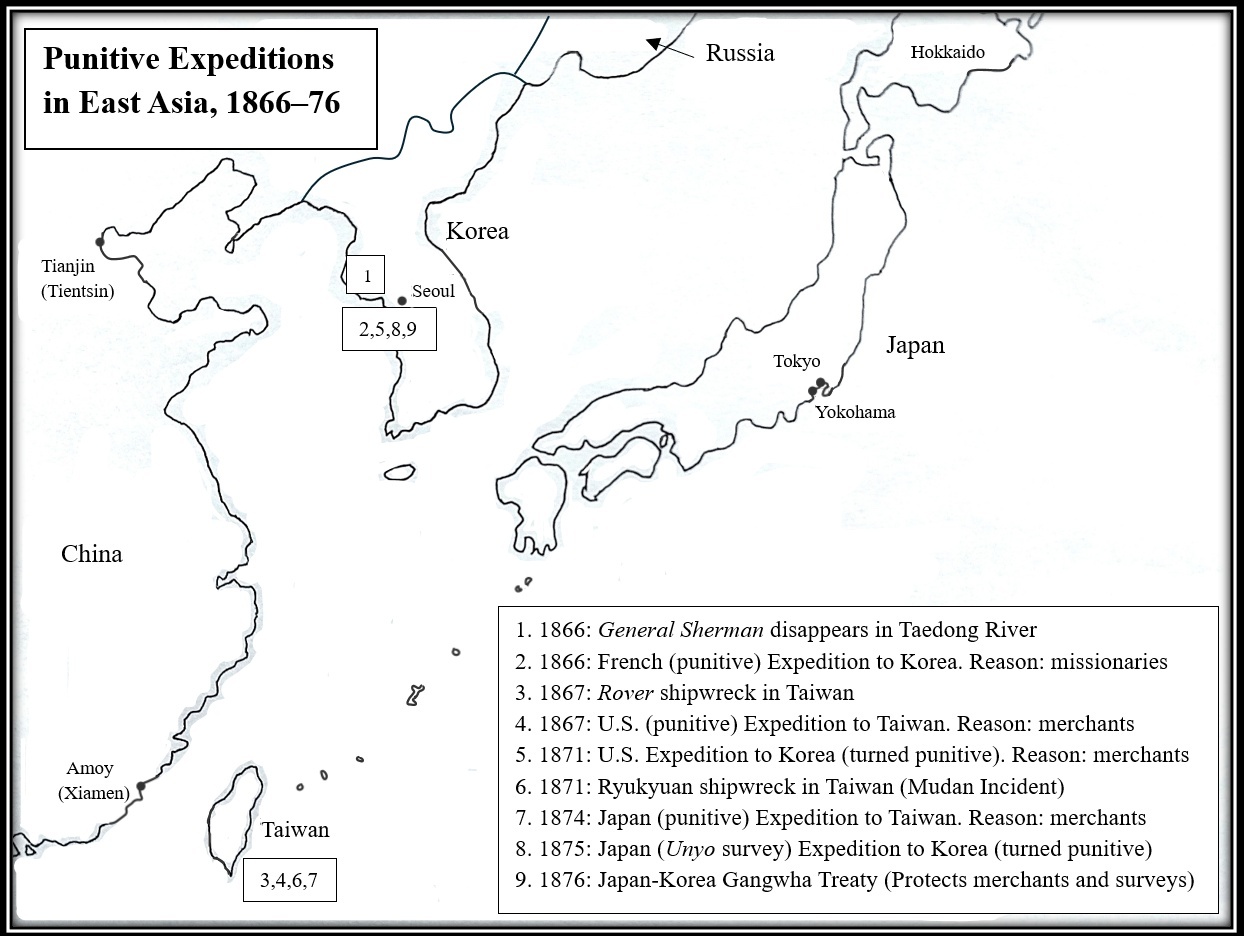
The U.S. expedition to Taiwan preceded the Iwakura Mission, but American involvement in Japan’s expedition there ensured that it adhered to existing doctrines and justifications. In mid-March of 1867, an American barque named Rover, captained by Joseph Hunt, hit a reef off the southern Taiwanese coast. The shipwrecked crew of thirteenth, along with Hunt’s wife, Mercy G. Hunt, managed to make it to land in a longboat but were massacred by a tribe of native Taiwanese. One lone survivor of Chinese ethnicity made it twenty miles north to the port of Takow (Kaohsiung), where the report was forwarded to authorities. By the beginning of April, news of the massacre made its way to General Charles W. Le Gendre, the American council to the Chinese coastal city of Amoy (Xiamen), who departed immediately to Taiwan to make further inquiries into the location of the shipwreck and veracity of the account. On 11 May, after meeting with Chinese officials in Fuzhou – which held jurisdictional authority over the island – Le Gendre was able to confirm the report – adding that British Commander George E. Broad of HMS Cormorant revisited the scene of the shipwreck on 26 March with the survivor. Le Gendre noted that when Broad attempted to land, he was “fired on from the jungle, which was so dense that it would have been folly to attempt to penetrate it… and returned to the ship” (NACP no. 224–9, 11 May 1867; Gordon 1957, 279). Le Gendre added that when he arrived in Fuzhou 2 April he immediately met with the “viceroy” of the province and demanded Chinese authorities do something to punish the perpetrators and “order the civil and military authorities of Formosa to immediately rescue, if possible, such of the survivors” – invoking Treaty of Tientsin articles XI and XIII. Article XI granted the privilege of unrestricted trading in Taiwanese (and other) ports, while Article XIII stipulated that the Chinese government could not place restrictions on foreign nationals employing Chinese subjects (NACP, no. 229–30).
More importantly, the British vice consul in Takow informed Le Gendre 22 April that “Chinese authorities of Formosa had so far failed to rescue the wrecked crew” or punish the perpetrators of the massacre. This assessment was corroborated by Broad’s interview with the “chief of the settlement” on 24 April, who claimed “so far the Chinese authorities had not sent forward any force against the Aborigines or anyone to enquire about the circumstances” of the killings (NACP, no. 230–2). This lack of action was all Le Gendre needed to take matters into his own hands. In response, Rear Admiral Henry H. Bell and Le Gendre launched a punitive expedition mid-June after informing Chinese authorities and receiving permission to meet the Taiwanese prefect to settle the issue. The expedition included more than one hundred and eighty sailors, officers, and marines. In a report to US Secretary of Navy Gideon Wells, Bell wrote that the indigenous Taiwanese avoided fighting and “displayed a stratagem equal to our native Indian. Delivering their fire they retreated without being seen by our men, who… frequently fell into ambush” (“American Operations in Formosa” 1867). One officer was killed in the skirmishing, but what proved more disastrous for the group was the combination of intense marching and tropical heat. More than a dozen soldiers fell victim to heat strokes.
There was no input from the US State Department informing the expedition because Le Gendre’s reports were received in September. When the American press began reporting about the expedition in August, they vilified the Taiwanese natives. Washington DC’s Evening Star ran the headline: “The Savages on the Island of Taiwan,” and disseminated Admiral Bell’s account of the lawless and anarchic nature of the population. “Formosa is divided between three different races of men – Chinese, half-breeds of aboriginals and Chinese, and wild savages, who wear scarcely any clothing.” Describing Taiwan and its peoples as a lawless wilderness made it easier for the Japanese to later launch their own expedition. “Many American and European vessels have disappeared off the south end of Formosa at various times,” the editorial read, “and it has long been surmised have perished at the hands of the natives and half-breeds infesting that part of the coast.” Furthermore, in helping to build a case justifying future expeditions, Bell noted that the natives of the eastern part of Taiwan had “no government” with which to negotiate. In essence, Bell blamed Chinese authorities. “I am satisfied that the barbarities of these savages cannot be permanently stopped until the Government at Peking induced by action of American and other foreign ministers at that court”. Bell’s solution to the anarchy was to “occupy all the villages and bays on the coast, and drive the aboriginals back into the interior of the island” (“The Savages on the Island of Taiwan” 1867). Sensitive to outcries for intervention, the Chinese sent several hundred soldiers to Taiwan shortly thereafter. Assuming control of that expedition was Le Gendre, who returned to Amoy harbouring an obsession to subdue the island. According to reporting from London’s Daily News, during Le Gendre’s second trip a “deputation of Chinese interceded for the savages, and offered security for their future good behavior” (“China” 1867).
1871 Korea and U.S. Precedent
Like Taiwan, the Korean peninsula represented another possible frontier for exploitation and access to larger inland markets. France launched a punitive expedition to the isolationist kingdom in 1866 in retribution for the execution of its missionaries, but the U.S. expedition there in 1871 was notable for its death and destruction. Prompting that endeavor was the 1866 disappearance of a U.S. merchant vessel named General Sherman, which was last seen in the Taedong River near Pyongyang. The disappearance of the vessel led American officials to assume the crew had been killed. US Secretary of State Hamilton Fish initially sent the mission to effect “at least a treaty providing for the kind treatment of shipwrecked people” but also instructed Frederick Low, the US Ambassador to China and the minister in charge of the mission, to ascertain “information of the loss or destruction of the American schooner… in case the reports of the wrongful treatment of the crew prove correct, indemnity or satisfaction therefor.” In addition, Fish noted that if “opening up” Korea to American merchants were a possibility, then Low should pursue it (“The Expedition to Korea” 1871).
Despite the relatively benign instructions, the expedition resulted in more than two hundred and forty Koreans killed, along with the destruction of a handful of forts erected near the Han River estuary to protect the capital Hanyang (Seoul). As expected, the refusal of the Koreans to negotiate led to calls in the press for intervention predicated on the assumption that the isolationist kingdom was uncivilized and damaged American honor:
It will be remembered that the expedition… was a pacific one. Our government wished to ascertain exactly the fate of the crew of the “General Sherman,” …But having had experience of the French method of inquiring after missing Frenchmen, the Coreans could not conceive of our approach for other than warlike purposes… Any loss of prestige with the Coreans would almost surely affect our standing with China and Japan, and might lead to restrictions… In the interests of humanity and trade, therefore, it would only seem our duty to go forward. If the Coreans cannot be induced by friendly means to afford us the security civilization demands, is it not desirable to convince them by hard knocks? (“The War in the Corea” 1871)
British opinion in Shanghai concurred. The editors of the Shanghai Courier believed that although the “Corean authorities must feel that they have suffered a bloody and humiliating punishment… if nothing more be done, there will be a sad end in store for those foreigners, of whatever nationality, who are unfortunate enough to be driven to those rockbound shores.” Their conclusion was that the Americans “should not desist” in further efforts because “the United States of America owe it to the civilized world” (“The Expedition to the Corea” 1871). The use of the terms ‘civilized’ and ‘uncivilized’ was common rhetoric informing decisions to launch expeditions against lower-status targets. In the case of Korea, the protection of shipwrecked sailors (of any nationality) and restitution of American pride was sufficient justification for intervention.
President Ulysses S. Grant and his cabinet reviewed the expedition’s outcome and even considered returning with a more formidable alliance that included Great Britain and Germany, but the idea was shelved. One newspaper articulated what Grant had probably concluded: that the “ends of the expedition having been fully accomplished, and the insult to the flag properly avenged” (“The Corean War” 1871). Homer B. Hulbert, an American who would later become a missionary in Korea and advocate of Korean independence in the early decades of the twentieth century, noted that the Koreans viewed the American withdrawal differently. “The approach of American gunboats up the very ‘Gibraltar of Korea’ was taken by the regent as a declaration of war,” he wrote, acknowledging that the deaths were “but a small price to pay for their exultation for seeing the American vessels hull down the Yellow Sea” (Hulbert 1906, 119). Korea thus retained its isolation for a few more years while the Japanese debated whether to engage the kingdom in like fashion. Ultimately, affairs with Taiwan took precedence, and were prompted by the slaughter of forty-four shipwrecked Ryukyuans in Taiwan that autumn – an event later named the Mudan Incident. Writing in 2009, Norihito Mizuno properly surmises that the “proposal for a punitive expedition against the Taiwanese aborigines who had maltreated Japanese subjects could have been considered a normal action to demonstrate Japanese sovereignty by protecting their people among the ‘civilized’ nations of the time” (Mizuno 2009, 701; Mayo 1972, 795–6; Leung 1983, 262).
‘In conformity with all doctrines’
Although the 1867 U.S. expedition to Taiwan ended in failure, the historian Edwin Pak-Wah Leung argued in the early 1980s what Mizuno alludes to when using the term ‘normal action’ – that “Japan looked to the American expedition as a precedent justifying a punitive expedition of their own against Taiwan” (Leung 1983, 267). As noted, the precipitating event for that expedition was the Mudan Incident. Soejima Taneomi, a key Meiji-era statesman who navigated the legal terrain involving extraterritoriality in the 1872 María Luz Incident – a case involving a Peruvian cargo ship carrying indentured Chinese collies anchored at Yokohama – was in a good position to usher Japan upon a new Taiwanese strategy given his accumulated knowledge of the legal regime governing maritime and international law. Like the Korean expedition five years later, the expedition was predicated upon the oft-used right to protect its citizens and redress perceived insults against national honor (Crawford 1984; Okubo 1981).
According to the renowned twentieth-century historian of Japan, Hilary Conroy, it was Charles DeLong, the American minister in Tokyo who recommended “his old friend” Le Gendre to Soejima to assist in organizing an expedition. “The Taiwan scheme emerged from the shirt-sleeves diplomacy of the U.S. Minister” who wanted “to prevent the Sino-Japanese Treaty of 1871 from becoming an Oriental alliance against Western states” (Conroy 1983, 138–9; Crawford 1984, 583). After resigning his consul position in late 1872, Le Gendre worked to gain the good graces of Soejima prior to his mission to China in 1873 – a mission in which Soejima met the Tongzhi Emperor and other important officials (JACAR 1873, Peking, May 12, 24). The three main objectives of that mission included Japanese claims over the Ryukyu Islands, (retroactive) compensation for the 1871 Ryukyuan massacre in Taiwan, and to address various concerns about Korea (Mc Williams 1975, 237–8). When Japan’s demands for compensation were predictably rejected, the Frenchman-turned-American East Asian consultant was more than ready to resolve the “affair of honor” regarding Taiwan (Thomson 1971, 449).
Many of Le Gendre’s memoranda were not only specific about how to invade the island, but laid the necessary public relations groundwork for a Western audience once news of the expedition reached the shores of Europe and North America. In a message to Soejima two months before the launch, Le Gendre stressed that “great care” be taken to ensure that the “plan is in conformity with all doctrines.” What Le Gendre meant was that the Japanese needed to justify the intervention using Western laws sanctioning punitive expeditions. From that perspective, it is no coincidence that Japan created a Bureau for Aboriginal Affairs of Taiwan one month before sending the expedition on May 6, 1874. “In offering my views as to the best mode of organizing the personnel of the expedition now contemplated,” Le Gendre informed Soejima 13 March, “I will suppose that the Japanese government… civilize the whole aboriginal population with a view to make them useful both to themselves and to the Japanese government after they have been pacified” (JACAR 1874, March 13; Gordon 1965, 175).
Le Gendre embroiled the U.S. even further by assisting the Japanese in employing two U.S. military officers as foreign advisors, Douglas Cassel and James Wasson. Like Le Gendre, Cassel was a Civil War veteran and lieutenant who served in the expedition to Korea in 1871. Wasson was also a Civil War veteran who at West Point befriended President Grant’s son, Frederick D. Grant, before acquiring a secretary job at the U.S. legation in Japan. To avoid conflicts of interest, both men (like Le Gendre) resigned their positions prior to advising the expedition. Wasson, who worked with the Hokkaido Colonization Office before his Taiwan commission, ended up becoming the chief of staff for General Saigo Tsugumichi – the expedition’s commander and the younger brother of Saigo Takamori. According to the historian Roger D. Cunningham, “three-fifths of the 78 foreigners” in Hokkaido were American. “This has led one modern historian to speculate that the Japanese may have viewed Americans as best qualified for service owing to the United States’s experience with frontier expansion and development” (Cunningham 2004, 7–8). This assessment was affirmed in 2001 by the diplomatic historian David M. Pletcher, who wrote that a “considerable amount of American advisory effort was focused” on Hokkaido, as it represented “the closest approximation to a Japanese frontier” (Pletcher 2001, 164). In that sense, the adoption of punitive expeditions at sea and on land to aggrandize territory aligned with existing conventions used by Americans on their western frontier. A few weeks preceding the operation, Le Gendre wrote General Saigo that the advance party led by Captain Cassel would land early May at the east coast village of Pilam (Taitung) to “establish a military colony” in anticipation of the arrival of the main force led by Saigo (JACAR 1874, March 31).
Unsurprisingly, the expedition was not successful in subduing the Taiwanese natives. In addition to intermittent skirmishing and grueling marches, a deadly bout of malaria inflicted hundreds of Japanese soldiers and their American advisors. The court of international opinion, however, was another matter, and the American press generally sanctioned the expedition. The Japanese were aware of the existing animosity Americans held toward the natives of Taiwan, and played that up in dispatches intended for Western consumption. The result was the establishment of a frontier narrative contrasting Japanese civilization to indigenous barbarity and backwardness. One paper claimed that “The expedition was well received by the Chinese settlers and half-castes,” and noted that “For a long time these savages have murdered all crews of vessels so unfortunate as to be cast upon the island – English, American, and Japanese shipwrecked sailors, but the Japanese have suffered most” (“Japan’s Trouble with China” 1874). Another popular New York newspaper claimed that it was “important to remember that the Chinese have repeatedly proclaimed the ‘cannibals’ to be wholly outside their dominion” (“Formosa. Japanese Expedition Against the Island Pirates” 1874).
A vocal promoter of the civilization narrative was Edward H. House, a resident and advocate for a greater Japan and one of the principal Western correspondents living in Tokyo. House was a frequent contributor to numerous newspapers including the New York Herald, and was the only foreign journalist allowed to accompany the 1874 expedition. One year after going to Taiwan, House published a version of events supporting the action on behalf of the murdered Ryukyuan sailors. “Mariners from nearly every civilized nation were known to have been slaughtered outright, or to have perished from the inhuman treatment to which they were subjected.” More importantly, House proclaimed that Japan was ready to enter the imperial arena on western terms. “The fact had been thoroughly demonstrated that injuries to any of the subjects of Japan,” House wrote, “at least in Asiatic waters, would not pass unredressed. The region which had for years been a terror to all Eastern navigators would hereafter, through the action of Japan, be free from peril”. He also quoted Commissioner Okubo Toshimichi’s response to a predictably recalcitrant Chinese official regarding the situation – demonstrating that the Japanese had wholeheartedly embraced western legal-military doctrines to achieve their goals. “‘Now that communication is established between the Eastern and Western worlds,’” House quoted Okubo, “‘safety and protection must be accorded to the navigators of all nations. Formosa is a very important island in the direct highway of commerce, but its people are like pirates in their practices’” (House 1875, 1, 170, 196; Huffman 2003).
While the long-term repercussions of the expedition favored similar future initiatives, Le Gendre’s actions created a potential diplomatic crisis among shocked American officials when they learned prior to the launch than a “former” consul and two US Army officers played important roles in formulating Japan’s new imperial approach to its neighbours – neighbours that China viewed as traditional vassal states within its sphere of influence. On 1 May, reporting from Japan reached San Francisco and the following day the New York Herald ran a column and subtitle indicating: “War To Be Prosecuted By American Officers.” The article noted that the expedition was “of special interest” to Americans since their “naval, military, political and general details are all in American hands”. The Herald added that “even in its inception our late Minister at Yeddo [Tokyo], Mr. De Long was consulted, though it must be stated that the part he took in the matter did not meet the approval of the State Department at Washington” (“Japan and Formosa” 1874).
When the new US Minister to Japan, John A. Bingham, replaced Charles DeLong, he emphasized the American government’s official opposition to the employment of officers in the Taiwanese expedition. As soon as Le Gendre was informed of this by Bingham, the former responded with a letter justifying his actions and invoking his “obligations” to “our government under the constitution and the laws of the United States.” In addition, part of Le Gendre’s reasoning rested in the fact that Peshin Smith, a former State Department employee and legal advisor to Japan, believed the Japanese government had every right to punish the Taiwanese given the absence of Chinese accountability to atrocities. The other part of Le Gendre’s argument was based on the premise that it was Delong who had originally endorsed the expedition. “I shall not change my course,” Le Gendre wrote to Bingham in April of 1874, “I must continue to hold myself subject to the orders of the Japanese government, into whose employment I entered at the pressing official invitation of your predessessor [sic]” (JACAR 1874, April 22, 25; Leonard 1965, 171–2; Kidder 2010).
Bingham realized that his attempts to stop the expedition were too late – as both Wasson and Cassel had left for Taiwan before his efforts could make a difference. After Sino-Japanese relations deteriorated, and Le Gendre went to Amoy as Special Commissioner on behalf of the Japanese government to negotiate a settlement, Bingham asked the US chargé de’affaires in Peking, Samuel Wells Williams, to have Le Gendre arrested on his arrival to prevent him from further violating neutrality laws. Le Gendre was arrested 6 August, while Secretary of State Hamilton Fish settled the controversy by informing American diplomatic personnel in East Asia that Americans could be employed by Asian nations so long as an official state of war did not exist – which applied to Le Gendre. Most reports of Le Gendre’s meddling in East Asian affairs was downplayed or simply ignored by an American press eager to see Japan supplant China. News from San Francisco via Yokohama noted a certain “astonishment” of Le Gendre’s arrest while claiming “foreign ambassadors” were “eager… to deprive Japan of all kinds of foreign counsel in this emergency”. Furthermore, there was an insistence that the arrest of Le Gendre proved the existence of a double standard given that “No foreigners acting in behalf of China have been molested or interfered with in any way” (“Arrest of an Ambassador” 1874; Gordon 1965, 176–82; JACAR 1874, Aug. 31, Sept. 22).
Sometime shortly after his release, Le Gendre published a long essay titled, Is Aboriginal Formosa A Part of The Chinese Empire? The “dispassionate statement” built a case for Japanese aggrandizement in lieu of ongoing Sino-Japanese negotiations. Le Gendre argued Japan would “not violate the international law by annexing” Taiwan because China held only nominal possession over the island “at an anterior period” and had abandoned it (Le Gendre 1874, intro i, 9). Furthermore, Le Gendre cited Johann Kaspar Bluntschli’s Modern International Law (Das moderne Völkerrecht, 1868) to claim that what the Japanese were doing was exactly what the Americans did during the colonial period vis-à-vis native tribes, and what the U.S. was doing at the time on the western frontier with punitive expeditions. “Bluntschli… says that ‘the true line of conduct to follow on the part of civilized powers towards uncivilized tribes has already been traced and applied by the Puritans in New England and by William Penn in Pennsylvania.’” Punitive expeditions were therefore a mechanism available to civilized peoples and colonists when the guarantees of “undisturbed enjoyment of the soil” were abandoned and efforts to “civilize the savages” failed. “We have seen that not only has China not fulfilled these conditions with the aborigines of that part of Formosa now occupied by Japan,” Le Gendre concluded, “but that the history of her occupation of Western Formosa shows that she has never evinced even the slightest intention of doing so” (Le Gendre 1874, 18). Most outside observers in the West, including editors at the New York Herald, wholeheartedly agreed, arguing that the expedition “was one which concerned not only Japan, but the entire maritime world as well. In the broadest sense, its success would ensure relief from dangers which had beset commerce for a score of years” (“Formosa. Japanese Expedition Against the Island Pirates” 1874). This was the ‘doctrine’ that Le Gendre stressed upon the Japanese, which was informed by American precedent:
The right of a government to take all necessary measures for the protection of its subjects could never be disputed. The Americans had undertaken the same thing, in the same region, by two different processes – first, violently and afterwards pacifically. The Japanese plan proposed simply a reversal of this order of proceeding. That it could by any chance be opposed never entered their calculations. But their well grounded dread of foreign meddling kept them from betraying their purpose (Bluntschli 1886, 166; Halleck 1861; Le Gendre 1878, 7–9; Conroy 1960, 39–40).
Le Gendre was quickly released by the Qing government, and a settlement with the Japanese was reached. The soldiers were withdrawn from Taiwan in November of 1874, and the Civil War veteran returned to Japan. Less than a year later, on 20 September, 1875, a Japanese ship Unyo, commanded by Inoue Yoshika, landed with a small detachment of soldiers on Gangwha Island, Korea – the same island American soldiers attacked four years earlier. The Japanese reportedly killed three dozen Koreans and dispatched the imperial navy to enforce a blockade while negotiators worked to ensure Japanese merchants the right trade in Korean ports. Although the expedition to the same location as the Americans was not officially punitive – the resultant violence sent a powerful message to Korean leadership, and opened an era where Korea was continually on the defensive from powers who claimed higher status – and thus the right to intervene to redress perceived grievances and insults to national honor. “The instigators of previous acts of disrespect,” a report in the London Times stated, “lost their places and power” in Korea, but there was little doubt from the correspondent “that the Japanese assert for themselves a position of great superiority over the Coreans, and demand that the title given to the Mikado should imply an inferior and tributary relation to Japan” (“Japan and Corea,” 1875). The Japanese were beginning to hone their adaptive approach to western laws, conventions, and methods (JACAR 1874, Nov. 4, 1875, Jan. 1).
On 27 February, 1876, the Treaty of Gangwha was concluded between the Empire of Japan and the Korean Kingdom of Joseon. Negotiated by Kuroda Kiyotaka, a former officer in the Hokkaido Colonization Office, the treaty contained extraterritorial provisions granting Japanese citizens the same rights enjoyed by Westerners – including the obligation: to rescue Japanese sailors (Art. VI), allow free passage by “all navigators” extending to coastal surveys (Art. VII), and the stationing of Japanese government officers in Korean ports “for the protection of Japanese merchants” residing there (Art. VIII) (JMFA 1899, 2–3). In essence, Korea had become a frontier whose authorities could do little to prevent outside powers from aggrandizing themselves at their expense. The Americans led the way to Gangwha Island, and the Japanese followed. “What Americans have wrought in Japan,” Griffis concluded in 1899, “they have succeeded in doing also in Korea.” Invoking a common theme of the era, the pro-Japanese reformer accused the Koreans “of keeping out foreigners, devastating the frontiers, and restraining the people inside the country.” He also believed that “Perry’s peaceful opening of one hermit nation in 1854 was the model and inspiration in 1876 to Kuroda and Mori in luring Korea out of her cave by treaty instead of by bloodshed” (Griffis 1899, 122). This was the general consensus among many in the West who supported Japan’s efforts, but Griffis omitted the fact that dozens of Koreans had been killed to make the threat of additional force a very real possibility (Shin 2024; Kim 2023).
In essence, the shedding of blood in the 1875 Unyo (survey) expedition was exactly what forced the Koreans to change their policy, and despite the irrefutable evidence, Griffis continued to champion the Japanese as harbingers of progress. “On every squadron of war vessels, and with every army corps,” he wrote in 1901, “they will have a lawyer, yes, and one who knows international law. The Japanese believe in victories of peace even more than those of war” (Griffis 1901, 75). Moreover, Mori himself believed that the U.S. expedition to Korea was “unwarrantable” – but could not help but invoking similar themes regarding Japan’s role as a civilizational force in East Asia. “And while the British Government may deem it wise to use force in its dealings with the eastern nations,” he wrote in his 1872 work, The Japanese in America, “the American policy appears to adhere resolutely to the principles of peace, justice, and equal rights to all, notwithstanding the late unwarrantable operations of the American Navy on the coast of Corea.” In time, those opinions obviously changed, but what continued to persevere was the belief in Japan’s role as a civilizational force on East Asia’s indeterminate frontiers:
The changes for good that have taken place in Japan during the last few years, are a matter of wonder and satisfaction to the whole civilized world. The American people have been, since the memorable visit of Commodore Perry, taking great and special interest in the affairs of Japan… There rests upon Japan a great hope, as well as high responsibility, for the success of bringing about a healthy and exemplary civilization, which must take the lead among all the Asiatic nations (Arinori 1872, 157).
Conclusion
Ever since Vasco da Gama first landed on the west coast of India in the late fifteenth century Europeans had engaged in what was later known as ‘gunboat diplomacy’ to achieve their commercial and strategic goals in an increasingly globalizing world. However, the term confuses and obfuscates the important fact that using military force to prompt commercial relations with foreign states was displaced over time with punitive expeditions – which were carried out at sea and on land on a global scale in the nineteenth and early twentieth centuries. Unrestrained military intervention, cloaked in the rectitude of international law, is therefore a legacy of the Western system. In that regard, the endpoint for military action with the intention to aggrandize was annexation, and the abstract term only serves to muddle the historical development of the method. In short, law of the gun was reconstituted into something much more formidable. It was a right invoked by powerful states to redress grievances and commit violence ostensibly to avenge and protect its peoples and interests, but one that was entirely imperial. The consensus that formed around the new regime in the aftermath of the Napoleonic Wars coalesced to become a league of powerful nation-states acting in concert towards the goal of conquering frontiers and tribes who lay beyond traditional boundaries. Because the Japanese learned to adopt the rules and laws, they were included into that system. 1874 and 1876 therefore mark a turning point in history – with the Anglo-Japanese Alliance in 1902 affirming their entrance into a clique that was once the exclusive domain of Western powers (Best 2020; Ravina 2017).
When studying relationships between states during the nineteenth century there is a particular phraseology that disappears around the turn of the century. That phraseology is marked by the ‘frontier between’ such and such a state with a noticeable absence of the word ‘border’ – which is an assumption often made by historians who have long lived in the era of passports, embassies, and definable political boundaries appearing on maps that are infrequently amended. Frontiers, not borders, once defined the spaces between countries. As Katharine Bjork eloquently articulates, expeditions were therefore a way of exploiting the absence of authority in a region or undermining the sovereignty of weaker states viewed as ripe for expansion or exploit by more powerful contenders. It was a transitionary period where international law – once the tool for sustaining a balance-of-power between European states – turned itself outward to seek overseas possessions in a contest pitting the powerful. The U.S. entered that arena in the mid-nineteenth century and accelerated its overseas involvement after the Civil War, and Japan was inspired because the new empire had properly learned how to enable its interests by invoking the established rules (Bjork 2019, 7–8,200–1; Eskildsen 2019, 73–80; Yamamoto 2023; Phipps 2015; Morris-Suzuki 2020).
And yet, the powers did not view their aggression in imperial terms but believed in the righteousness of their mission to civilize the uncivilized corners of the world. In 1871, the same year as the Iwakura Mission to the U.S., Secretary of the Navy George M. Robeson issued an annual report that not only addressed the need for naval expansion and isthmian routes through Central America, but defined an ongoing struggle in stark Bismarckian language that would not have gone unnoticed by the traveling scholars who informed Japan’s future policy. “Barbarism will still respect nothing but power,” Robeson wrote, “and barbaric civilization repels alike interference, association, and instruction.” In his view, the “more enlightened and free of civilized nations” were the ones burdened with the task of extending the sphere of liberty – just as those who waged war against Mexico to conquer the American West and prosecuted the Civil War did so under the belief in their mission to extend the blessings of progress. A new frontier was laid before an America that ultimately justified military actions leading to the annexation of Pacific lands, and sovereignty officially extended to the shapeless boundaries between frontier and civilization – to wherever each respective power, including the Japanese, felt the need to protect it nationals in the name of advancement:
Not only on the shores and among the islands of our continent, but in every seaport of civilized Europe, in Asia, from the shores of the Bosphorus to the head of navigation of unnamed rivers on the confines of the Chinese Empire, in Japan, in the islands of the semi-continents of the East, and among the groups of the Pacific and Southern Oceans, our citizens claim and need our protection. In every corner of the known world they are found occupying every field which enterprise dares to invade or energy avails to conquer; and everywhere, outside of our own limits, wherever they enter, they carry with them affirmative, and sometimes aggressive ideas of freedom and progress antagonistic alike to the traditions, customs, and habits of the people, and the ideas and practices of local governments. Such is the result of our progressive civilization (“The Navy. Report of Secretary Robeson” 1871).
Appendix